If you’ve spent any time reading tech news lately, you’ve probably noticed that many people use “AGI” and “AI” interchangeably. They don’t. And understanding the gap between them matters whether you’re a business owner deciding how to use AI tools, a job seeker wondering what’s coming next, or simply someone trying to make sense of the headlines.
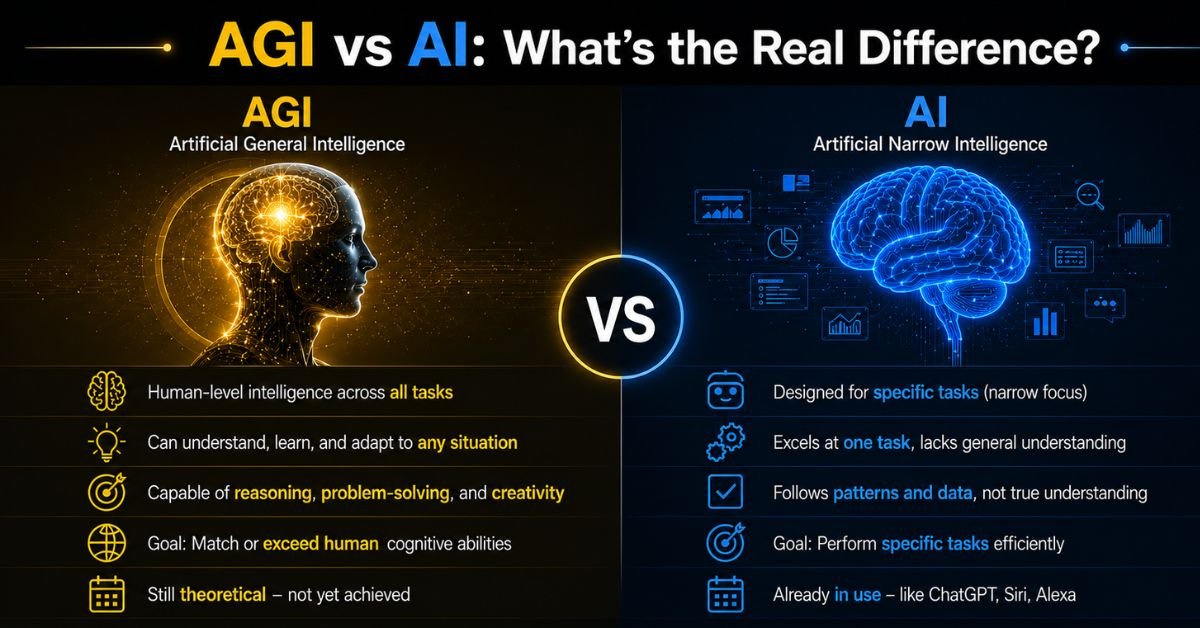
In short: AI already runs your spam filter, powers your GPS, and writes your emails. AGI — Artificial General Intelligence doesn’t exist yet anywhere in the world. It’s a proposed future stage of AI development where a machine could think, learn, and adapt across any task the way a human does, not just the narrow set of tasks that developers trained it to perform.
This article breaks down exactly what separates today’s AI from the AGI everyone keeps talking about, using plain language, real-world comparisons, and no unnecessary jargon.
What Is AGI in AI?
Artificial General Intelligence (AGI) is a category of AI research focused on building a system that can understand, learn, and apply knowledge across any intellectual task a human can perform — not just the one it was design and trained for.
Every AI tool you use today, no matter how impressive, is built to do a specific job. A chatbot handles conversation. A recommendation engine predicts what you’ll buy next. A fraud-detection model flags suspicious transactions. Each one is excellent within its lane and useless outside it.
AGI is the opposite idea. Instead of many separate specialists, it would be a single system capable of reasoning through new, unfamiliar problems, transferring what it learned in one domain to a completely different one, and doing this without requiring developers to retrain it from scratch each time.
It’s important to be clear: AGI is still a research goal, not a product. No company has built one, and there’s no agreed-upon date for when — or even if — one will exist.
The term itself dates back decades in AI research circles, long before the current wave of generative AI made “AI” a household word. Early computer scientists imagined a single machine that could match the flexible, adaptive intelligence of the human brain — not a collection of narrow tools. That original vision is essentially what AGI still refers to today, even as the underlying technology has changed dramatically, from rule-based systems to neural networks to today’s large language models.
What Does AGI Mean?
Breaking down the term itself helps clarify the concept:
- Artificial — created by humans, not biological.
- General — not limited to one task or domain; capable of handling a broad range of problems.
- Intelligence — the capacity to reason, learn, plan, and adapt.
Put together, AGI describes a machine intelligence that mirrors the flexibility of human cognition. A useful mental shortcut: today’s AI is a specialist, while AGI would be a generalist — closer to how one person can cook dinner, fix a leaking pipe, learn a new language, and negotiate a raise, all using the same underlying brain.
Researchers sometimes also use the term “human-level AI” as a rough synonym, though AGI specifically emphasizes the generality of the intelligence rather than just matching human performance on a specific benchmark.
How Does AGI Differ from Traditional AI?
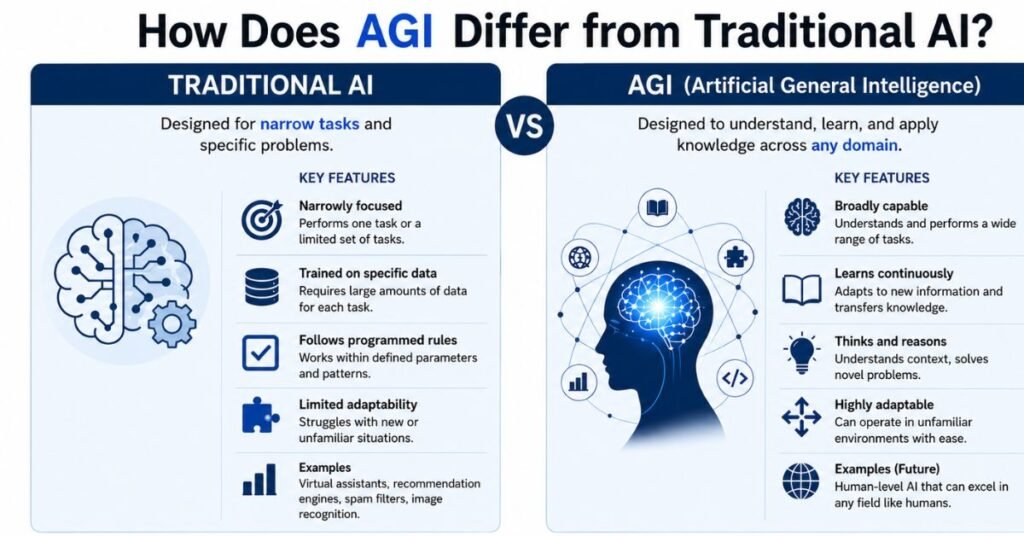
The clearest way to understand the difference is to look at how each type of system actually works.
Traditional AI — often called narrow AI — is built and trained for one job. A model that translates languages doesn’t know how to diagnose a car engine problem. A model that recognizes faces in photos can’t write a business plan. Even large language models, despite feeling conversational and flexible, are ultimately pattern-matching systems trained on massive datasets to predict likely next words — they don’t possess independent goals, self-awareness, or true understanding of the world.
AGI, by contrast, would need several capabilities that no current system fully has:
- Cross-domain reasoning — applying knowledge learned in one area to solve problems in a completely different area.
- Learning from limited data — picking up new skills from just a few examples, the way humans do, instead of needing millions of labeled samples.
- Autonomous goal-setting — determining its own sub-goals to accomplish a broader objective, rather than following a fixed, engineer-defined objective function.
- Common-sense understanding — grasping everyday physical and social realities that humans take for granted but that machines struggle to infer.
There’s also a structural difference in how developers build these systems. Developers typically train traditional AI models once for a specific purpose and then deploy them a spam filter stays a spam filter. By design, an AGI system would need to keep learning after deployment, updating its own understanding as it encounters new situations, much like a person accumulates knowledge and skills over a lifetime instead of finishing the learning process after school.
The table below summarizes the core distinctions.
| Aspect | Traditional AI (Narrow AI) | AGI (Hypothetical) |
|---|---|---|
| Scope | One task or domain | Any intellectual task |
| Training | Needs large labeled datasets per task | Would learn from limited examples |
| Adaptability | Fails outside its trained scope | Transfers knowledge across domains |
| Reasoning | Pattern recognition, statistical prediction | Human-like reasoning and planning |
| Availability today | Widely deployed | Does not exist yet |
| Examples | Chatbots, recommendation engines, image recognition | None — still theoretical |
AGI vs Narrow AI
“Narrow AI” is simply the formal name for the AI that exists today. It’s worth spending a moment on this comparison specifically, because it’s the one most people encounter daily without realizing it.
Narrow AI systems are sometimes remarkably capable — a chess engine can beat any human grandmaster, and a diagnostic model can spot certain cancers in scans more reliably than doctors. But that capability doesn’t transfer. The chess engine has no idea what a scan is. The diagnostic model can’t play chess. Each is optimized for a narrow reward function set by its developers, and each becomes unreliable — or simply breaks — the moment it’s pushed outside its intended use case.
AGI wouldn’t have that ceiling. A genuinely general system could, in theory, move between tasks the way a capable human employee can be handed a new project and figure out how to approach it using judgment, prior experience, and reasoning — not a retraining cycle.
| Feature | Narrow AI | AGI |
|---|---|---|
| Task range | Single, specific task | Unlimited range of tasks |
| Real-world status | Fully operational, in daily use | Purely theoretical |
| Skill transfer | None | Full transfer across domains |
| Human oversight needed | High, task-specific tuning | Uncertain — potentially self-directed |
| Risk profile | Well-understood, manageable | Largely unknown |
AGI vs Generative AI
This comparison causes the most confusion, mainly because tools like ChatGPT, Claude, and Gemini feel so conversational and “smart” that people assume they must be close to AGI. They aren’t — and understanding why clears up a lot of misplaced hype.
Generative AI refers to models trained to produce new content — text, images, audio, video, or code by learning statistical patterns from massive datasets. When you ask a generative AI model a question, it isn’t reasoning about the world the way a person does. It’s predicting the most statistically likely sequence of words (or pixels, or sounds) based on patterns in its training data.
That process can produce genuinely useful, creative, and human-sounding output. But it’s still narrow in an important sense: the model doesn’t have persistent goals, doesn’t understand cause and effect the way humans intuitively do, and can’t reliably reason through entirely novel situations it hasn’t seen analogues of during training.
| Aspect | Generative AI | AGI |
|---|---|---|
| Core function | Generates content based on learned patterns | Would reason, plan, and act across domains |
| Understanding | Statistical prediction, no true comprehension | Genuine understanding (theoretical) |
| Current status | Widely available and in production use | Does not exist |
| Best-known examples | ChatGPT, Claude, Gemini, Midjourney | None |
| Goal-directed behavior | Limited, task-prompted | Would be autonomous and self-directed |
Is ChatGPT AGI?
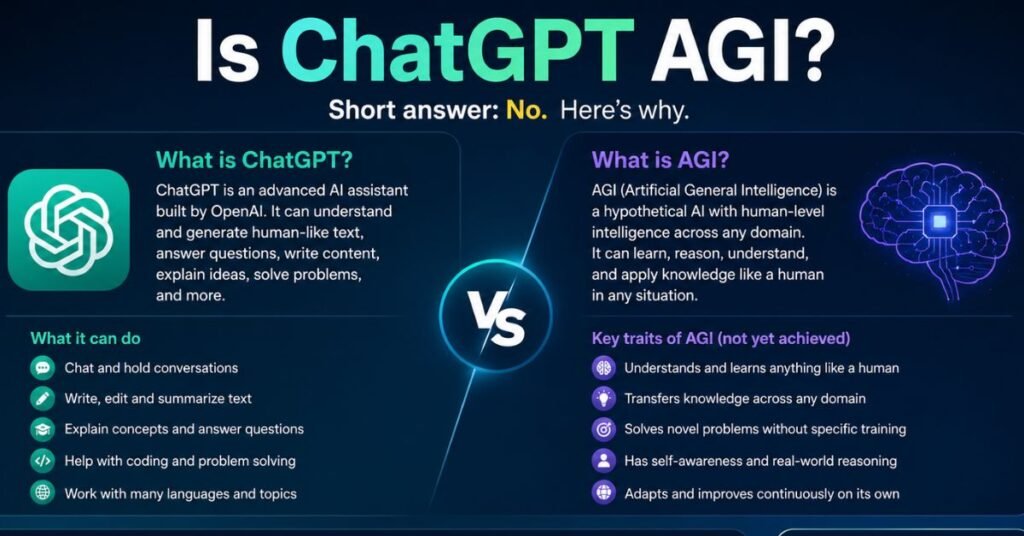
No. ChatGPT — like every other large language model available today — is a generative AI system, not AGI. It’s genuinely impressive at writing, summarizing, coding, and answering questions across a wide range of topics, and that breadth is exactly what makes people assume it’s “general” intelligence.
But breadth of topics isn’t the same as breadth of cognitive capability. ChatGPT doesn’t form persistent memories across unrelated conversations by default, doesn’t have independent goals, can’t take physical actions in the world on its own, and doesn’t genuinely “understand” concepts the way a human does — it recognizes and reproduces patterns from training data at massive scale. It can also confidently produce incorrect information, something a truly general intelligence with real understanding would be far less prone to doing in areas it has “reasoned through” correctly.
OpenAI itself has described AGI as a longer-term goal that its current models have not reached. The distinction matters: ChatGPT is a powerful narrow-to-broad generative tool, not a generally intelligent agent.
Is AGI Available Today?
No verified AGI system exists anywhere, at any company, as of today. This is one of the most consistently misunderstood points in AI discourse, largely fueled by marketing language and speculative headlines.
What does exist are increasingly capable narrow and generative AI systems that can handle a growing range of tasks — writing, coding, image generation, data analysis, customer service, and more. Some of these systems are described as showing “sparks” of general reasoning in narrow experimental settings, but none demonstrate the consistent, reliable, cross-domain autonomy that defines true AGI.
Predictions about when AGI might arrive vary enormously — from a few years to several decades, and some researchers argue current deep-learning approaches may never get there without fundamentally new architectures. Because there’s no formal, universally accepted test for “when a system officially becomes AGI,” claims that it’s imminent — or that it already exists internally at some lab — should be treated with healthy skepticism until independently verified.
Examples of AGI (Hypothetical)
Since AGI doesn’t exist yet, any “example” is necessarily speculative — useful for illustrating the concept, not describing something real. Commonly cited hypothetical scenarios include:
- A general household robot that can walk into any unfamiliar kitchen, locate ingredients, and cook a meal it has never been explicitly programmed to prepare — the classic “make me a cup of coffee in a stranger’s house” thought experiment.
- An autonomous project manager that takes a vague business goal, independently designs a strategy, delegates tasks, adjusts to unexpected setbacks, and resolves team conflicts without step-by-step human instructions.
- A universal problem-solver that can shift from diagnosing a medical case, to drafting legal arguments, to designing a bridge, applying transferable reasoning skills rather than domain-specific training.
- A self-directed scientist capable of forming its own hypotheses, designing experiments, and revising its understanding of a field the way human researchers do.
None of these exist today. They’re used in AI research and journalism purely to make the abstract idea of “general intelligence” easier to visualize.
Benefits of AGI
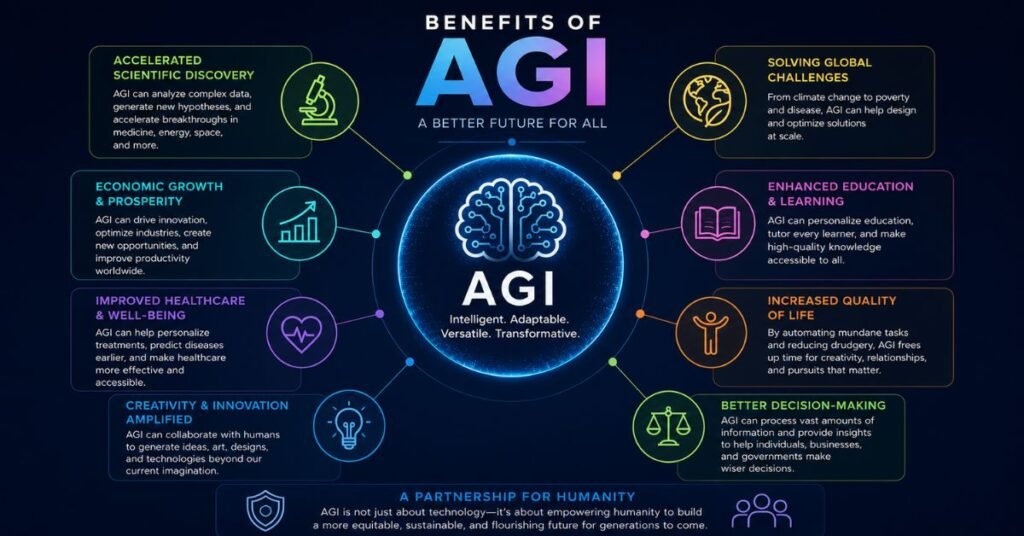
If researchers ever achieve AGI safely, it could offer a range of potential benefits that researchers and industry leaders often highlight:
- Accelerated scientific discovery — tackling problems in medicine, climate science, and physics that currently take human researchers years or decades.
- Universal problem-solving capacity — one system capable of contributing across industries instead of requiring separate specialized tools for each.
- Dramatic productivity gains — automating complex, multi-step cognitive work, not just repetitive tasks.
- Personalized education and healthcare — systems that adapt their reasoning to each individual’s needs rather than applying one-size-fits-all models.
- Solving problems humans haven’t cracked — from resource optimization to disease research, where the sheer complexity may benefit from non-human reasoning approaches.
AGI-focused labs frequently cite these benefits to justify continued research, even as they acknowledge the accompanying risks.
Risks and Challenges
The same qualities that make AGI potentially transformative are also what make it risky. Key concerns raised by AI safety researchers include:
- Misaligned goals — a system pursuing an objective in a way that technically satisfies its instructions but causes unintended harm.
- Loss of human oversight — if a system can independently set and pursue sub-goals, it becomes harder to predict or control its behavior.
- Concentration of power — whoever builds and controls a functioning AGI first could gain outsized economic and geopolitical influence.
- Economic disruption — the potential to automate cognitive labor at a scale and speed society hasn’t previously had to absorb.
- Security and misuse risks — a highly capable general system could be misused for cyberattacks, disinformation, or other harmful purposes if not properly safeguarded.
- Unclear accountability — determining responsibility when an autonomous system makes a consequential decision remains an unresolved legal and ethical question.
This is why major labs researching AGI also invest heavily in AI safety and alignment research — the effort to ensure any future advanced system reliably behaves in ways consistent with human values and intentions.
Companies Working on AGI
Several organizations have explicitly stated that building AGI (or ensuring it’s developed safely) is central to their mission. Here’s a general overview:
| Company | Stated AGI-Related Focus |
|---|---|
| OpenAI | States its mission is to ensure AGI benefits all of humanity |
| Google DeepMind | Long-term research mission centered on building general-purpose AI safely |
| Anthropic | Focused on AI safety research alongside frontier model development, aiming to ensure advanced AI systems are reliable and steerable |
| Meta AI | Pursuing advanced, general-purpose AI capabilities as part of its long-term research agenda |
| xAI | Focused on advancing AI capability with a stated aim of understanding the universe |
It’s worth noting that “working toward AGI” is a stated long-term mission for these companies, not a claim that any of them currently possess it. Their day-to-day releases remain narrow and generative AI products — chatbots, coding assistants, and multimodal models — even as their research divisions explore more general capabilities.
Will AGI Replace Jobs?
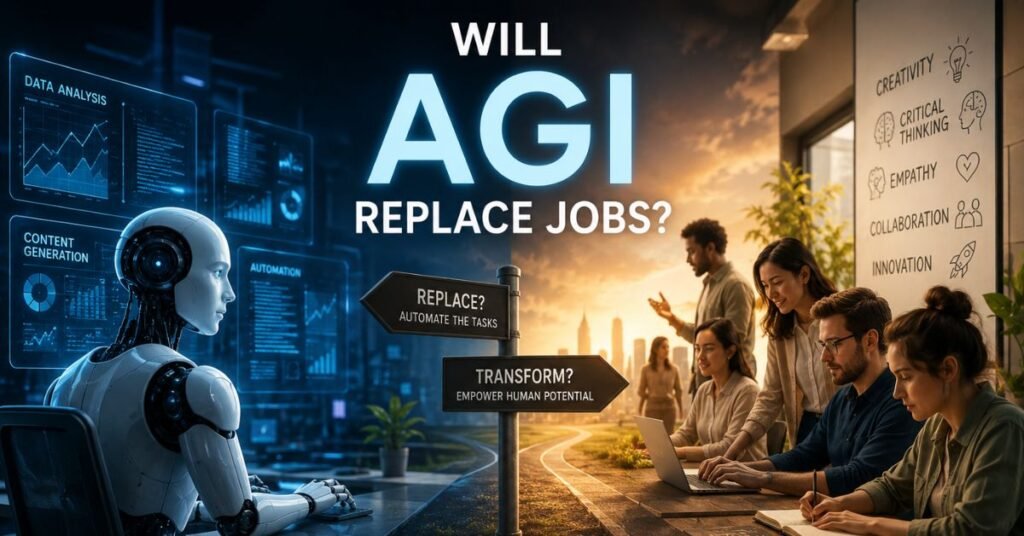
This is the question people care about most, and the honest answer is: it’s uncertain, but the direction of concern is reasonable.
Even without AGI, today’s narrow and generative AI is already automating pieces of many jobs drafting content, writing code, analyzing data, and handling customer inquiries. This is reshaping roles rather than eliminating entire professions overnight, and it’s already happening.
If AGI were eventually achieved, the disruption potential would be far larger, because a general system could theoretically perform the reasoning component of many jobs, not just repetitive or rules-based tasks. Economists and labor researchers differ sharply on what this would mean in practice:
- Some argue AGI would primarily augment human workers, similar to how past technologies (computers, the internet) displaced some roles while creating new ones.
- Others argue AGI’s generality makes this transition fundamentally different from past automation waves, since it wouldn’t be limited to one sector or skill category.
- Most agree that the pace and management of any transition — through policy, retraining, and gradual deployment — would heavily influence how disruptive it actually is.
For now, the realistic takeaway is that narrow and generative AI are the tools reshaping jobs today. AGI’s employment impact remains speculative because AGI itself doesn’t exist yet.
The Real Near-Term Impact of AI on Jobs
That said, it’s worth separating the short-term picture from the long-term one. In the next few years, the more realistic risk isn’t a single AGI system taking over entire professions — it’s narrow AI tools gradually absorbing specific tasks within jobs, pushing workers toward roles that emphasize judgment, oversight, and skills that current AI still handles poorly, such as complex negotiation, hands-on physical work, and nuanced interpersonal decision-making. Planning around that nearer-term shift is far more actionable today than planning around a hypothetical AGI timeline that no one, including the researchers building frontier models, can predict with confidence.
Conclusion
The line between AI and AGI isn’t just technical trivia — it’s the difference between tools we already rely on daily and a technology that remains, for now, theoretical. Today’s AI, including advanced generative models like ChatGPT, is narrow: powerful within its lane, limited outside it. AGI represents a future stage of AI development that would remove that ceiling entirely — and with it, bring both far greater potential benefits and far greater risks.
Frequently Asked Questions
What is the main difference between AI and AGI?
AI performs specific tasks it was trained for, while AGI would be able to reason and learn across any task, the way a human can. AGI does not exist yet.
Is AGI more powerful than ChatGPT?
AGI would be far more capable in principle, since it could reason across unlimited domains. ChatGPT is a generative AI tool limited to pattern-based text generation.
When will AGI be created?
There’s no agreed timeline. Estimates from researchers range from a few years to several decades, and some believe it may not happen with current methods at all.
Does any company currently have AGI?
No. No company has publicly demonstrated a verified AGI system as of today, despite some marketing claims suggesting otherwise.
Is AGI dangerous?
It could pose significant risks if not developed carefully, including misaligned behavior and loss of human oversight, which is why AI safety research is a major focus for labs pursuing it.
What’s the difference between AGI and ASI?
AGI would match human-level intelligence across domains, while ASI (Artificial Superintelligence) refers to a hypothetical system that would exceed human intelligence entirely. Neither currently exists.