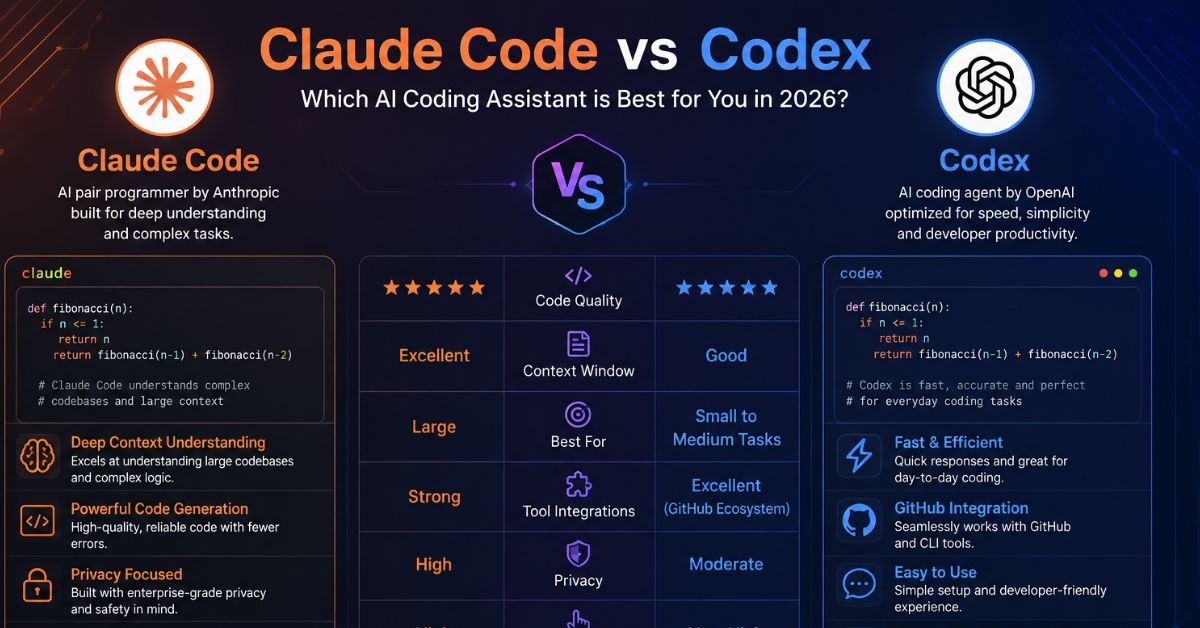
Picking between Claude Code and OpenAI Codex used to come down to gut feeling. In 2026 it’s a real decision with real trade-offs: different pricing ladders, different sandboxing models. Different agent architectures, and benchmark numbers that shift depending on which harness ran them.
This guide breaks down what actually separates the two tools today. Using verified pricing pages and multiple independent benchmark trackers rather than marketing claims.
TL;DR: Claude Code vs. Codex
Both tools now start at $20 per month and are bundled into broader subscriptions instead of being sold separately.
Claude Code is included with every paid Claude plan, including Pro, Max, Team, and Enterprise. It emphasizes extensibility through features like CLAUDE.md project memory, Skills, Hooks, Subagents, Plugins, and MCP servers.
Codex is included with every ChatGPT plan, including limited access on the free tier. Its focus is a fast, sandbox-first coding agent that can run cloud tasks unattended for extended periods.
Neither tool “wins” outright. Claude Code tends to edge ahead on deep refactors, long-context codebase reasoning, and structured multi-agent workflows.
Codex tends to edge ahead on raw task throughput, parallel cloud runs, and tight ChatGPT/GitHub integration. If you already pay for one ecosystem, that’s usually reason enough to start there before paying for both.
What is Claude Code?
Claude Code is Anthropic’s agentic coding tool. It runs in the terminal, inside VS Code and JetBrains, through a standalone desktop app, on the web at claude.ai/code, and on iOS.
Under the hood, Claude Code uses what Anthropic describes as an agentic loop. The model reads files, selects the right tools, executes commands, edits code, and runs tests automatically.
It also manages long coding sessions through context compaction, helping it retain important information while staying within the model’s context window. Safety boundaries come from permission modes, checkpoints, sandboxing, and admin-managed settings.
What makes Claude Code distinct is its extension model. Instead of one big system prompt, Anthropic split functionality into separate primitives:
- CLAUDE.md – a memory file read at the start of every session that anchors project conventions, build commands, and style rules
- Skills – folders containing a SKILL.md file plus optional scripts or templates, invoked automatically or via slash command
- Subagents – specialized instances with their own isolated context, useful for research, review, or debugging without polluting the main conversation
- Hooks – shell commands that fire on events like tool use, session start, or stop, useful for enforcing tests-before-commit or blocking edits to generated files
- Plugins – bundles that package skills, subagents, hooks, and MCP servers together as one installable unit
- MCP servers – the Model Context Protocol connects Claude Code to external systems: GitHub, databases, Sentry, Slack, and thousands of other integrations
Same underlying loop is exposed programmatically through the Claude Agent SDK, which is how teams wire Claude Code into CI/CD pipelines, GitHub Actions, and scheduled jobs.
What is Codex?
OpenAI Codex is OpenAI’s coding agent, distinct from the old 2021 Codex API model that has been fully retired. The current Codex works two ways. Locally, it runs as a CLI or IDE extension that behaves like an interactive pair programmer.
In the cloud, you can delegate a task and Codex works inside an isolated sandbox for anywhere from a few minutes to several hours, then reports back with a diff, logs, and cited test runs. Codex is available on the web, as a VS Code extension, via CLI, on iOS, and through Amazon Bedrock.
Codex’s strength is throughput. Because cloud tasks run in disposable containers, you can kick off several in parallel and let them work unattended while you do something else, then review diffs when they’re ready.
It integrates tightly with GitHub for automated code review and pull request workflows, and configuration is handled through an AGENTS.md file rather than CLAUDE.md.
Claude Code vs Codex: What are the differences?
Models and pricing: the $20 vs $100 asymmetry
Both companies now anchor their entry tier at $20 a month, but what that $20 buys differs.
| Claude Pro | ChatGPT Plus | |
|---|---|---|
| Monthly price | $20 ($17/mo billed annually) | $20 |
| Coding agent included | Claude Code | Codex (CLI, IDE, web, iOS) |
| Models available | Sonnet 5, Opus 4.8, Haiku 4.5 | GPT-5.5 (general-purpose, used for coding tasks) |
| Usage window | Shared 5-hour rolling limit across Claude and Claude Code | Shared 5-hour rolling limit across Codex web, CLI, and IDE |
| Free tier | Yes, with light Claude Code access | Yes, limited Codex Mini access |
| Next tier | Max at $100 (5x usage) or $200 (20x usage) | Pro at $100 (5x usage) or $200 (20x usage) |
| Team pricing | Team Standard $20-25/seat, Premium $100-125/seat | Business $20-25/seat (2-seat minimum) |
The two ladders now mirror each other almost exactly: $20 entry, $100/$200 power tiers, similar per-seat team pricing. The real difference shows up in usage economics, not sticker price. Claude’s paid plans share one usage pool across chat and Claude Code, so a heavy coding day eats into the allowance you’d otherwise use for regular Claude conversations.
Codex works the same way on the ChatGPT side. Neither vendor publishes a fixed message count, since usage depends on model choice, context length, and task complexity.
On the API side, costs are billed strictly per token rather than through a subscription.
Anthropic’s current coding-focused pricing includes Sonnet 5 at $2 per million input tokens and $10 per million output tokens through August 31, 2026, after which it increases to $3/$15. Opus 4.8 costs $5/$25, while Haiku 4.5 is priced at $1/$5. All three models support prompt-caching discounts.
OpenAI’s Codex CLI can also use a pay-per-token API key instead of a ChatGPT subscription. In that case, usage is billed at the standard OpenAI API rates for whichever GPT-5-series model you choose.
Tokens per task: where the real cost lives
The sticker price rarely reflects your actual monthly cost. For both tools, the biggest expenses come from large-context workloads, such as scanning entire monorepositories, repeatedly running failed tests, or keeping long agentic sessions active while the model works through a fix.
Prompt caching is the biggest cost-saving feature on both platforms. Anthropic charges much less for cached reads than standard input, while OpenAI also offers discounted pricing for cached input tokens through its API.
If you’re tracking costs closely, focus on cache hit rate and output token usage rather than the advertised per-token price. On both platforms, output tokens typically contribute more to your final bill than input tokens.
Surface coverage: terminal-first vs everywhere
Claude Code started as a terminal-first tool and has since expanded to IDEs, a desktop app, the web, and iOS. Even so, the terminal remains its most capable and feature-rich environment.
Codex has focused on broad platform support from the beginning. It is available through the CLI, VS Code, a web dashboard for delegating tasks, iOS, and Amazon Bedrock.
If your workflow is “type a prompt, walk away, and return to a finished pull request,” Codex’s cloud-task model is designed for exactly that use case.
If you prefer to stay involved, review each step, and maintain a fast feedback loop, Claude Code’s interactive terminal experience generally feels more natural.
Sandboxing: kernel layer vs application layer
Both tools sandbox agent actions so an autonomous coding session can’t casually damage your machine or repository. The difference lies in how each platform approaches isolation and control.
Claude Code combines permission modes, checkpoints, and configurable sandboxing with its agentic workflow. This gives you fine-grained control over how much autonomy the agent has on a per-project basis.
Codex takes a different approach by running cloud tasks inside fully isolated, disposable containers by default. That provides a stronger safety boundary for unattended, long-running jobs, although it offers less control over intermediate steps while a task is running.
Harness depth: Skills, Hooks, Plugins, Subagents, Dynamic Workflows
This is where Claude Code has invested the most engineering effort. Skills let you package reusable, domain-specific instructions that Claude invokes automatically.
Hooks let you enforce hard rules, like running tests before Claude is allowed to stop, or blocking edits to files under a generated/ directory, deterministically rather than hoping the model remembers a prompt instruction.
Subagents isolate research or review work in a separate context window so it doesn’t crowd out the main task. Plugins bundle all of the above into one shareable, installable unit for a team.
Codex has its own Skills marketplace and supports custom automations, but it doesn’t expose an equivalent layered stack of hooks and subagents in the same granular way; its strength is closer to raw task delegation at scale than fine-grained workflow orchestration.
AGENTS.md vs CLAUDE.md: the open-standard moment
Both tools read a markdown file at the root of a repo to learn project conventions, build commands, and style preferences. Claude Code uses CLAUDE.md. Codex, along with a growing list of other coding agents, uses AGENTS.md, which has been positioned as an open, tool-agnostic standard so a single file can brief multiple agents at once.
In practice, many teams now maintain an AGENTS.md as the canonical source and either symlink or auto-generate a CLAUDE.md from it, so you’re not maintaining duplicate instructions for each agent you use.
Which is faster: Claude Code or Codex?
There’s no single, universal answer, and any article claiming one definitive winner is oversimplifying the comparison.
Independent benchmarks show GPT-5.5 and Claude Opus 4.8 performing within about a percentage point of each other on SWE-bench Verified, with both scoring in the high-80% range as of mid-2026.
On the more demanding SWE-bench Pro benchmark, which focuses on longer, multi-file engineering tasks, standardized scores are lower across the industry—typically around 55–60%. The ranking can also change depending on which evaluation harness is used.
In everyday use, perceived speed often depends more on the type of work than on raw model performance. Codex’s parallel cloud tasks make batches of smaller, well-defined changes feel faster overall, while Claude Code’s tightly supervised interactive sessions often complete complex refactors with fewer unnecessary iterations.
Autonomous vs. interactive: how each tool works
The clearest mental model is this: Claude Code defaults to interactive, and Codex defaults to autonomous. In Claude Code, a typical session looks like a conversation. You describe a task, Claude proposes a plan or a diff, you approve or redirect, and the loop continues until the task is done. Plan mode lets you review an entire approach before any file gets touched. Codex leans the opposite direction. You hand off a task description, Codex spins up a sandboxed environment, works through the problem end to end, including running its own tests, and only surfaces once it has something to show you. Both tools support the other mode to a degree, Claude Code has a “let it run” autonomous setting and Codex has an interactive CLI session, but the defaults reveal what each vendor optimized for first.
Context awareness and codebase understanding
Context window size stopped being the main differentiator once both vendors pushed toward the million-token range for their top-tier models, but how each tool uses that context still differs.
Claude Code’s session management is built around compaction: as a long session fills up, older, less relevant context gets summarized rather than dropped outright, which tends to preserve project-specific decisions made earlier in the session.
Codex’s cloud tasks are more stateless by design; each task spins up a fresh container with a scoped view of the repo relevant to that task, which keeps individual tasks fast and cheap but means it doesn’t naturally carry forward the kind of running project memory that a long interactive Claude Code session accumulates.
CLAUDE.md and AGENTS.md both partially compensate for this by giving each agent a persistent, human-written brief that survives across sessions regardless of what the model itself remembers.
Configuration and customization (AGENTS.md vs. CLAUDE.md)
Beyond the root config file, both tools let you scope instructions more granularly. Claude Code supports nested CLAUDE.md files in subdirectories, so a monorepo can give different conventions to its frontend and backend packages without one bloated root file.
It also supports team-wide settings pushed through managed configuration, useful for enforcing a consistent permission model across an engineering org.
Codex supports similar directory-scoped AGENTS.md files and workspace-level settings inside ChatGPT Business and Enterprise, including admin controls over which repos and integrations a given team can connect.
Neither system requires you to touch code to change agent behavior, which is part of why both have been adopted well beyond hardcore terminal users.
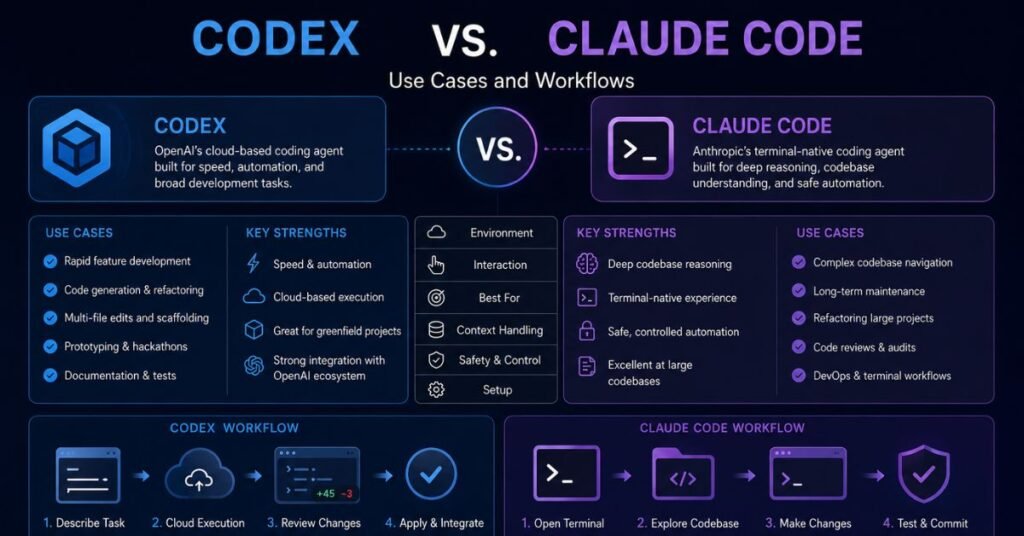
Codex vs. Claude Code: Use Cases and Workflows
Best for rapid prototyping
When you’re sketching a new feature or standing up a throwaway proof of concept, speed of iteration matters more than architectural rigor. Codex’s ability to spin up a task, let it run, and hand you a working diff a few minutes later fits this well, especially when you’re comfortable reviewing and adjusting after the fact rather than steering every step.
Claude Code’s interactive mode also works fine here, but its strength is less pronounced when the task is simple enough that there’s not much for a careful, step-by-step reviewer to add.
Best for large codebases
Large, unfamiliar codebases reward an agent that can hold a lot of context and reason about how a change ripples across files it hasn’t directly touched. This is where Claude Code’s long-context handling and compaction strategy tends to show up in developer reports as an advantage, particularly for monorepos with cross-package dependencies.
Codex handles large codebases too, but its per-task, sandboxed model means a single cloud task’s view of the repo is more scoped, which is efficient for a self-contained fix but can miss cross-cutting implications a broader session would catch.
Best for complex refactoring
Multi-step refactors, the kind where step three depends on a decision made in step one, are consistently where developers report Claude Code doing well, largely because the interactive loop lets you course-correct mid-task instead of discovering a wrong turn only after the whole task finishes.
Codex can absolutely handle refactors, and it strengthens trust in autonomous changes by showing exactly which tests it ran to validate each result. However, genuinely complex refactors usually benefit from a human reviewing each intermediate step during the session.
Best for CI/CD integration
Both tools have real CI/CD stories. Claude Code exposes its agentic loop through the Claude Agent SDK, letting teams script it into GitHub Actions, pre-commit hooks, and scheduled jobs as a one-shot process without needing a terminal session.
OpenAI built Codex’s cloud tasks around this workflow from the start and tightly integrated GitHub for automated pull request reviews and task delegation. If your primary use case is automatically reviewing every pull request, Codex’s cloud-task architecture offers a slight edge in polish.
If you want to run a scripted agent within a broader deployment pipeline with custom guardrails, Claude Code’s hook system provides greater flexibility.
Pros and Cons of Codex vs. Claude Code
Codex advantages
- Bundled into every ChatGPT plan, including a limited free tier, so the barrier to first use is low
- Cloud tasks run fully isolated and in parallel, which suits batch work and unattended automation
- Deep GitHub integration for automated code review
- AGENTS.md is gaining traction as a cross-tool standard, reducing lock-in
Codex limitations
- Less granular control over intermediate steps during autonomous cloud tasks
- Weaker equivalent to Claude Code’s hooks and subagents for enforcing deterministic guardrails
- Shares the same 5-hour usage window across web, CLI, and IDE, so heavy use in one surface reduces headroom in another
Claude Code advantages
- Deepest extension model of the two: Skills, Hooks, Subagents, Plugins, and MCP servers give fine-grained, auditable control
- Strong reported performance on deep, multi-file refactors and long-context reasoning
- Available across terminal, IDEs, desktop, web, and iOS, with the terminal experience the most mature
- Agent SDK makes it straightforward to script the same loop into CI/CD
Claude Code limitations
- No free standalone tier; requires at least a paid Claude Pro subscription or API credits
- Usage is shared across chat and coding within the same plan pool, same trade-off Codex has on the ChatGPT side
- Parallel, fully unattended cloud-task workflows are less central to the product than they are for Codex
Output quality and speed: what the benchmarks show
Benchmark numbers for these two tools move fast enough that any specific figure printed today may be stale within weeks, and different trackers (Anthropic’s own reporting, OpenAI’s own reporting, and third-party aggregators like Scale AI’s SWE-bench Pro leaderboard) don’t always agree, because they use different scaffolding, prompting, and averaging methods. A few things are consistent across sources as of mid-2026:
- SWE-bench Verified, the original and most widely cited benchmark, has largely plateaued in the high-80s to mid-90s percent range for frontier models from both labs, meaning it’s no longer very discriminating between the top tier.
- SWE-bench Pro, a newer and deliberately harder benchmark built from longer, more realistic multi-file pull requests, still has meaningful headroom, with standardized-harness leaders scoring roughly 55-70% depending on the tracker.
- Terminal-Bench 2.0, which measures agentic terminal-task competence rather than pure code correctness, is where Codex’s newest models have posted some of their strongest independently-reported numbers.
- Vendor-reported numbers on each company’s own scaffold tend to run 10-20 percentage points higher than the same model’s score under a neutral, standardized harness, so treat any single headline benchmark with some skepticism and look for numbers that cite their methodology.
The practical takeaway: on pure code-correctness benchmarks, Claude’s and OpenAI’s top coding models are close enough that the benchmark gap shouldn’t be your deciding factor. Workflow fit, pricing structure, and which ecosystem your team already lives in matter more.
You May Also Like
Best AI Coding Tools in 2026: Cursor vs Claude Code vs Copilot vs Replit Agent
When to use Claude Code vs Codex
When Claude Code is the right call
- You’re doing deep, multi-file refactors where getting it right matters more than getting it fast
- You want fine-grained control over agent behavior through hooks, subagents, and permission modes
- Your team is already standardized on Claude for chat, and you want coding usage to draw from the same subscription
- You need a long-context session (1M-token context is available on Sonnet and Opus tiers) to hold an entire monorepo or documentation set in view at once
- You want to enforce deterministic guardrails, like “always run the test suite before finishing,” rather than relying on the model remembering an instruction
Choose Codex If…
- You want to fire off several independent tasks in parallel and review finished diffs later
- Your workflow already centers on GitHub pull requests and you want automated review baked in
- You’re already paying for ChatGPT Plus or Pro and don’t want a second $20+/month subscription
- You need the agent to run unattended for long stretches inside a fully isolated container
- You’re working across a codebase that already uses AGENTS.md as its agent-briefing standard
Codex vs. Claude Code Pricing and Cost Considerations
For most individual developers, the entry-level decision is simpler than the pricing pages make it look. Claude Pro at $20/month ($17/month billed annually) and ChatGPT Plus at $20/month are functionally equivalent entry points, and both include their respective coding agent at no extra cost. Where it gets more complicated is scaling past that first tier.
On the Claude side, the jump from Pro to Max is a straight usage multiplier: 5x more capacity for $100/month, or 20x for $200/month, with no change in which models you can access. On the Codex side, ChatGPT Pro follows the same shape: 5x usage at $100/month or 20x at $200/month, also without gating you into a different model tier.
Both companies moved away from simple per-message pricing during 2026 toward token- or credit-based accounting under the hood, which means the headline plan price tells you less than it used to about what a heavy day of usage will actually cost against your allowance.
Teams face a similar mirror image. Claude’s Team plan splits into Standard seats (around $20-25/month per seat) and Premium seats (around $100-125/month per seat, required for Claude Code access), with a minimum seat count.
ChatGPT Business runs $20-25/seat on annual billing with a two-seat minimum, and includes Codex without needing a separate premium seat tier. If your team is small and cost-sensitive, that structural difference, Codex on every Business seat vs. Claude Code requiring the pricier Premium seat, can matter more than any benchmark score.
Subscription vs. API Costs
Anyone running either agent through pay-as-you-go API billing instead of a subscription should budget around prompt caching carefully. Both platforms discount cached input tokens heavily (roughly a 90% discount on cache reads), and output tokens are consistently the more expensive side of the bill on both sides.
A subscription usually becomes more cost-effective once you cross a fairly low daily usage threshold, making API access a better choice for bursty, automation-focused workloads than for everyday interactive coding.
Can you run Claude Code and Codex together?
Yes, and a meaningful number of teams do. Because each tool reads its own configuration file (CLAUDE.md and AGENTS.md respectively) and neither requires exclusive access to your repo, you can run both against the same codebase.
Teams often use Codex to handle batches of small, independent cloud tasks—such as dependency updates, straightforward bug fixes, and boilerplate test generation—in parallel, while they rely on Claude Code to tackle harder, single-threaded problems that require a human to review every step.
The cost of doing this is simply paying for two subscriptions, or two sets of API credits, so it makes the most sense for teams rather than solo hobbyists watching every dollar.
How do you give either agent live web access?
Neither tool has unrestricted internet access by default; both gate it behind an explicit capability. Claude Code and the broader Claude platform let users enable web search for each session or API call, with separate billing from token usage.
Codex also supports web access through configured MCP-style tool connections or, on the API side, through OpenAI’s built-in web search tool parameter. In both cases, treat live web access as an opt-in capability you grant deliberately, especially in automated or unattended runs, since letting an autonomous coding agent fetch and act on arbitrary web content carries real security implications.
Claude Code vs Codex: Which should you choose?
If you’re unsure which one to choose, the simplest approach is to start with the ecosystem you’re already paying for. Claude Pro or Max subscribers can try Claude Code at no additional cost, making it an easy way to access a capable coding agent with excellent refactoring abilities and strong long context reasoning.
Meanwhile, ChatGPT Plus or Pro users already have access to Codex, whose parallel cloud-task model is particularly effective for handling a backlog of smaller, well-defined development tasks.
Neither tool has a durable, benchmark-proven lead over the other as of mid-2026; both labs ship updates roughly every few weeks, and the gap that exists today can close or reverse by the time you read this. The better question than “which is better” is “which fits how my team actually works.”
You May Also Like
Best AI Tools for Product Managers in 2026: A Workflow-by-Workflow Guide
Conclusion
Codex vs. Claude Code isn’t a contest with a permanent winner in 2026. Both well-funded labs now ship competitive coding agents on a similar cadence, offer pricing tiers that look nearly identical from the outside, and post benchmark scores so close that methodology matters more than the headline number.
Claude Code’s advantage is depth: a layered system of skills, hooks, subagents, and MCP servers built for teams that want precise, auditable control over an agent working in their codebase.
Frequently Asked Questions
What’s the pricing difference between Codex and Claude Code?
Both start at $20/month bundled into a broader subscription (Claude Pro or ChatGPT Plus), with $100 and $200 power tiers on each side. Neither is sold as a standalone product.
Which is faster, Claude Code or Codex?
Neither has a consistent lead on raw model speed; Codex often feels faster in aggregate because it runs tasks in parallel, while Claude Code often finishes hard single tasks with fewer wasted iterations.
Which produces better code quality on complex tasks?
Independent benchmarks put current top models from both labs within a few points of each other on SWE-bench Verified. Many developers report Claude Code doing better on deep, multi-file refactors specifically.
Can I use both Claude Code and Codex together?
Yes. Since each reads its own config file (CLAUDE.md vs AGENTS.md) and neither claims exclusive repo access, many teams run both against the same codebase for different task types.
Does Codex support MCP servers like Claude Code?
Codex supports its own tool and automation ecosystem, including a Skills marketplace, but Claude Code’s MCP integration and layered hooks/subagents system is generally considered the more granular of the two.
What’s the difference between Codex CLI and Codex Cloud?
Codex CLI runs interactively on your machine like a local pair programmer. Codex cloud tasks run unattended inside an isolated container and report back a diff once finished.
Can I use Claude Code through ChatGPT Plus, or Codex through Claude Pro?
No. Each coding agent is bundled exclusively with its own company’s subscription plans; there’s no cross-platform bundling between Anthropic and OpenAI.
Which has better sandboxing, Claude Code or Codex?
Codex’s cloud tasks default to fully isolated, disposable containers. Claude Code offers configurable permission modes and sandboxing you can tune per project. Both are considered solid; the right fit depends on how much control you want mid-task.
Should I switch from Claude Code to Codex, or vice versa?
Only if your current tool is genuinely failing your workflow. Given how close the two are on quality, switching subscriptions purely to chase a benchmark headline rarely pays off.
How do I give either agent live access to the web?
Both gate web access behind an explicit, separately billed tool rather than granting it by default, so you enable it deliberately per session or per API call.