Every week, another teacher, editor, or hiring manager runs a piece of writing through an AI detector and treats the score as gospel. That single number then decides grades, bylines, and job offers. It shouldn’t, at least not on its own.
AI detection tools are genuinely useful when you understand what they measure and what they miss. This guide walks through how they work, why they sometimes flag real human writing, which tools hold up under independent testing, and what Google actually does with AI-assisted content. No hype, no inflated accuracy claims, just what the evidence shows going into the second half of 2026.
What Is an AI Detection Tool and How Does It Work?
An AI detection tool is software that estimates the likelihood that a piece of text, image, or audio clip was produced by a machine learning model rather than a person. It doesn’t scan a database of known essays the way a plagiarism checker does. Instead, it studies the statistical fingerprint of the writing itself.
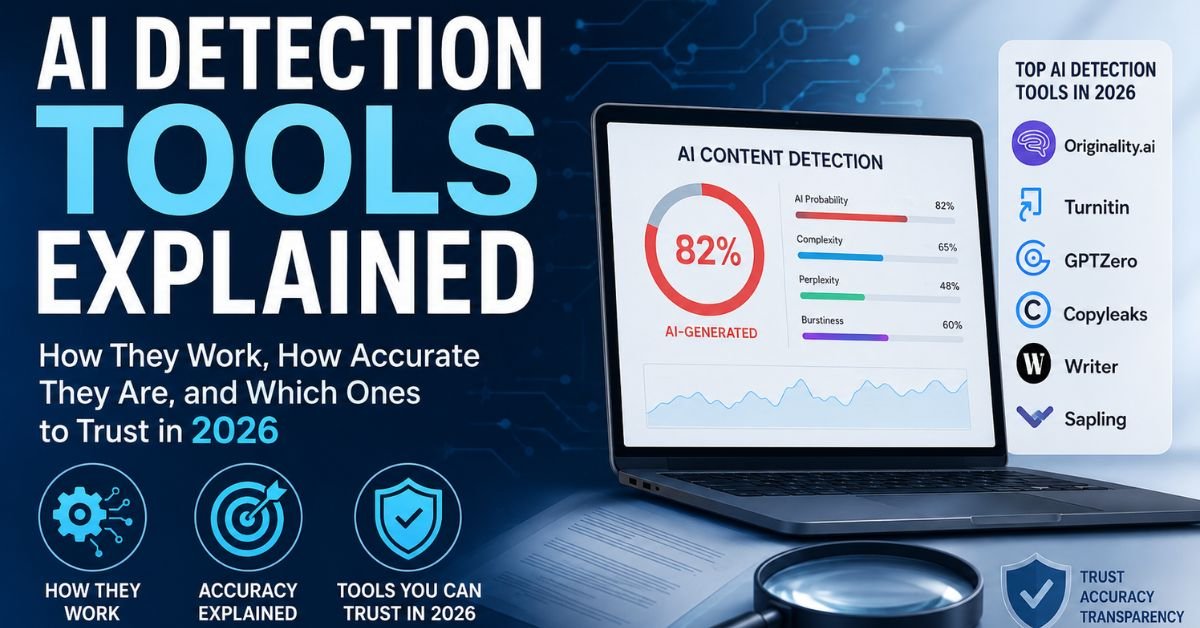
Most text detectors are themselves small language models. They read a passage and effectively ask: how likely is it that I would have generated this sequence of words? If the phrasing looks like the kind of safe, statistically probable output a language model tends to produce, the tool leans toward an AI verdict. If the writing has odd turns of phrase, inconsistent rhythm, or the small imperfections typical of a person typing quickly, it leans human.
The output is never a certainty. It’s a probability score, usually shown as a percentage, sometimes broken down sentence by sentence so a teacher or editor can see exactly which lines triggered the flag.
Core signals AI detectors rely on
- Perplexity – how predictable the word choices are across a sentence
- Burstiness – how much sentence length and structure vary across a paragraph
- Token probability patterns – whether each word matches what a language model would statistically choose next
- Stylistic fingerprints – repeated phrasing habits associated with specific chatbots
- Metadata and watermarking – hidden signals some AI platforms embed in their output, when present
How Do AI Detectors Detect ChatGPT and AI-Generated Text?
Detecting ChatGPT-style output comes down to two measurements that show up again and again in the research: perplexity and burstiness. Language models generate text by picking the next most statistically likely word, over and over. That habit produces smoother, more predictable prose than most people naturally write.
Perplexity measures how surprising a piece of text is to a reference model. Low perplexity means the wording is exactly what you’d expect a model to produce. Human writing usually scores higher because people make idiosyncratic word choices, digress, and occasionally write clunky sentences that a model would never generate on its own.
Burstiness looks at rhythm instead of word choice. Human authors naturally mix short punchy sentences with long, winding ones. Early AI models tended to output paragraphs with a flatter, more uniform sentence length, which detectors learned to flag. Newer models have gotten better at varying rhythm, which is part of why detection has gotten harder.
Beyond perplexity and burstiness, some tools compare a submission against a database of known AI outputs, or check for digital watermarks that certain AI platforms quietly embed in generated text. That approach works well against unedited output from a specific known model, but it falls apart the moment someone paraphrases the text or runs it through a different tool entirely.
How Accurate Are AI Detection Tools in 2026?
Accuracy in 2026 is a moving target, and it depends heavily on what kind of text you feed the detector. Reported accuracy across major tools ranges from roughly 65% up to the mid-90s, and that range shrinks fast once paraphrasing or light human editing enters the picture.
Independent testing tells a more useful story than vendor marketing pages. A recent seven-detector benchmark using 500 essays under three conditions found that raw, unedited AI text was caught reliably by the strongest tools. Once that same text was paraphrased, accuracy dropped sharply across every detector tested. When the text was passed through a purpose-built humanizing tool, every single detector in the study returned a zero percent flag rate.
| Condition | Top detector accuracy | Weakest detector accuracy |
|---|---|---|
| Raw, unedited AI text | ~96% | ~78% |
| Paraphrased AI text | ~72% | ~41% |
| Humanized AI text | 0% (all tools) | 0% (all tools) |
That last row matters more than any single vendor’s marketing claim. It means a detector score can confirm suspicion, but it can never prove the absence of AI involvement. A clean scan tells you the text wasn’t flagged, not that no AI was used at any stage of drafting.
Text length also skews results. Short passages under a few hundred words give detectors far less statistical signal to work with, so scores on short-form content should be treated with extra caution. Formal, technical, or heavily structured writing can also read as “too perfect” to a model trained mostly on casual human text, which pushes the score toward AI even when a person wrote every word.
Can AI Detectors Detect Human-Written Content by Mistake?
Yes, and it happens more often than most people assume. This is called a false positive: a detector flags genuine human writing as AI-generated. It’s the single biggest reason educators and publishers are told never to treat a detector score as final proof.
The clearest documented pattern involves non-native English writers. Multiple academic studies, including widely cited work from Stanford researchers, found that AI detectors misclassified more than 60% of essays written by non-native English speakers as AI-generated, compared to a small fraction of essays from native speakers under the same test conditions. The likely explanation is that non-native writers often use more formal, simplified sentence structures, which lowers perplexity and burstiness in exactly the way AI text does.
Formal or overly polished writing carries the same risk. A student who writes in short, grammatically correct, low-variation sentences can trigger a false flag purely because their natural style resembles the statistical pattern a detector was trained to catch. Real-world consequences followed: one widely reported case involved a 17-year-old student wrongly accused of academic misconduct after a detector assigned her original essay a roughly 30% AI probability score. The accusation was eventually walked back, but the disruption to the student had already happened.
Why human writing sometimes reads as “AI” to a detector
- Simple, grammatically clean sentence structures with little variation
- Formal academic or technical tone with predictable phrasing
- Short passages that don’t give the model enough signal
- Non-native English patterns that overlap statistically with AI output
- Heavy editing by grammar tools like Grammarly before submission
Best AI Detection Tools to Check AI-Generated Content
No single detector wins across every category. Independent testing consistently shows different tools excelling at different jobs, so the right pick depends on who is using it and what happens if the score is wrong.
| Tool | Best for | Notable strength | Known limitation |
|---|---|---|---|
| GPTZero | Educators and students | Sentence-level highlights, writing-process replay, generous free tier | Higher false-positive rate on formal or ESL writing |
| Originality.ai | Content teams and publishers | Strong independent accuracy scores, bundled plagiarism check | Paid only, no meaningful free tier |
| Copyleaks | Enterprise and multilingual teams | Low false-positive rate, 30+ languages, text/image/video coverage | Pricing scales quickly for high volume |
| Turnitin | Universities and schools | Highest raw accuracy in several head-to-head tests | Not available to individuals outside institutions |
| Winston AI | Agencies screening freelance content | Bulk scanning, shareable client reports | Mid-tier accuracy on paraphrased text |
| Sapling | Developers building detection into a product | API-first design | Misses a meaningful share of paraphrased AI text |
For a quick self-check before submitting a document, a free tool is usually enough. For anything with real consequences attached, like a grading decision or a publishing contract, pairing two different detectors and reviewing the writing process yourself is the safer path.
Free vs. Paid AI Detectors: Which One Is Better?
Free detectors are built for quick, low-stakes checks. They’re fine for a writer who wants a general sense of whether a draft reads as too uniform, or a student double-checking a paper before submission. Paid tools exist for situations where the result carries real weight: enterprise publishing pipelines, university misconduct cases, or agencies vetting freelance writers at scale.
| Factor | Free detectors | Paid detectors |
|---|---|---|
| Typical accuracy | Lower, more inconsistent | Higher, especially on longer text |
| False positive rate | Often higher | Usually lower, tuned for fairness |
| Word limits | Small, per-scan caps | Bulk scanning, higher or unlimited limits |
| Extra features | Basic score only | Source highlighting, API access, team dashboards |
| Data privacy | Text often stored by default | Clearer retention and deletion policies |
| Best use case | Personal, quick self-checks | Institutional or business decisions |
The honest answer is that price doesn’t guarantee accuracy on its own. Some free tools outperform paid competitors on specific content types, and some expensive enterprise platforms still miss paraphrased text. What paid tiers reliably buy you is better documentation, audit trails, and support when someone disputes a result, which matters far more than the raw score once real decisions are on the line.
GPTZero vs. Copyleaks vs. Other AI Detection Tools
GPTZero and Copyleaks come up in almost every comparison, and for good reason. They approach the same problem from different angles. GPTZero built its reputation in classrooms, with sentence-level highlighting and a writing replay feature that shows a document’s edit history as extra context. Copyleaks leans into enterprise use, combining AI detection with plagiarism scanning, multilingual support, and image and video checks in one dashboard.
On raw, unedited AI text, both tools perform well in independent testing, generally landing in the low-to-mid 90s for accuracy. The gap widens on fairness. Several benchmarks have found Copyleaks holds a noticeably lower false-positive rate than GPTZero, which matters most in academic settings where a wrongly flagged student pays the price.
| Category | GPTZero | Copyleaks |
|---|---|---|
| Primary audience | Educators, students | Enterprises, publishers, legal teams |
| False positive rate | Higher in most independent tests | Among the lowest tested |
| Language support | Strong in English | 30+ languages |
| Extra tools | Plagiarism check, writing replay | Plagiarism, image, and video detection |
| API and integrations | Available, less deep documentation | Deeper enterprise API and SDK support |
| Pricing model | Free tier plus paid plans | Credit-based, scales with volume |
Other tools worth knowing: Originality.ai regularly posts some of the strongest independent accuracy numbers for content-marketing use cases, Turnitin remains the default inside universities because of its LMS integration, and ZeroGPT tends to underperform both on accuracy and false positives in side-by-side testing. None of these tools should be treated as a final verdict. They’re a starting point for a conversation, not the end of one.
Can AI Detectors Detect ChatGPT, Gemini, Claude, and Other AI Models?
Detectors generally do a reasonable job on unedited output from major chatbots, but performance varies by model and drops the moment someone edits the text. Detection also gets harder over time, because each new model generation writes with more natural variation than the last.
Older GPT-3.5-era text tends to be the easiest to catch, since its sentence rhythm and word choice were more mechanically uniform. Output from newer, larger models such as GPT-4-class systems, Gemini, and Claude tends to score lower on the same detectors, simply because these models produce more varied, less predictable prose by design. Some detectors are trained specifically on ChatGPT output and perform worse when tested against a different model family, which is one reason results can differ so much between tools scanning the exact same document.
A few practical points worth knowing:
- No detector reliably names which specific AI model produced a text. Most only estimate the probability that any AI was involved.
- Detection accuracy on raw output from newer models is generally lower than on older models, across nearly every tool tested.
- Mixed human-AI writing, where a person drafts with AI assistance and then edits heavily, is the hardest case for every detector on the market.
- Paraphrasing tools and “humanizer” services can push detection scores close to zero regardless of which model originally generated the draft.
Why Do AI Detectors Produce False Positives?
False positives happen because AI detection is fundamentally a statistics problem, not a fact-checking problem. Human and AI writing overlap in the underlying feature space that detectors measure, so a boundary that catches all AI text while flagging zero human text is mathematically impossible to draw.
Several specific factors push the false-positive rate up in practice. Formal, simplified sentence structure, common among non-native English writers, mirrors the low-perplexity pattern detectors are trained to associate with AI. Short passages don’t give a model enough text to build a confident statistical picture, so scores swing unpredictably. Heavy grammar-checking software can also smooth out the natural irregularities that make writing read as human, nudging a genuine draft toward an AI-sounding profile.
Vendors sometimes report false-positive rates measured at strict detection thresholds that don’t match how the tool behaves at its default, more sensitive setting. That gap between marketing numbers and real-world default behavior is a big part of why two people can run the same essay through the same tool and get wildly different confidence levels depending on settings they never touched.
AI Detection Tools for Students, Teachers, Writers, and Publishers
Different users need different things from a detector, and picking based on your role avoids a lot of wasted time.
Students get the most value from a free, quick self-check before submitting work, mainly to catch phrasing that reads unnaturally uniform. Running a personal draft through a detector is not proof of anything, but it can flag sections worth rewriting in your own voice.
Teachers should treat any score as a conversation starter, never a verdict. Pairing a detector result with a look at draft history, earlier writing samples, and a direct conversation with the student protects against the kind of false-positive cases that have made headlines.
Writers and freelancers working with agencies or platforms that scan submissions benefit from understanding which tools their clients use, since GPTZero, Copyleaks, and Originality.ai behave differently on the same text. Keeping drafts, outlines, and revision history on hand gives you something concrete to point to if a score comes back unexpectedly high.
Publishers and content teams generally need bulk scanning, team dashboards, and an audit trail more than a marginally higher accuracy number. This is where paid, enterprise-grade tools earn their cost, particularly for sites publishing at volume where one bad flag can hold up an entire editorial queue.
AI Detection and SEO: Does Google Detect AI-Generated Content?
Google does not penalize content for being AI-generated. Google’s own guidance, first published in 2023 and reaffirmed since, states plainly that the company evaluates content quality, not the method used to produce it. There is no public Google AI detector flipping a switch on rankings based on an AI probability score.
What Google’s spam systems do target is content published at scale primarily to manipulate search rankings, regardless of whether a human or a machine wrote it. This falls under what Google calls scaled content abuse. Sites that publish large volumes of thin, repetitive, unedited AI output built purely to capture search traffic are the ones getting hit, and they’d likely have been hit under the same policy even before generative AI existed, back when the tactic was spinning existing articles with synonym swaps.
The practical takeaway for anyone publishing AI-assisted content:
- Google ranks on helpfulness, accuracy, and originality, not on production method
- Content built to satisfy a search engine first and a reader second is the actual risk, not AI involvement itself
- Human review, fact-checking, and original insight are what separate ranking content from penalized content
- Disclosure of AI assistance is a transparency choice, not a Google ranking requirement
- E-E-A-T signals, meaning demonstrated experience, expertise, authority, and trust, matter more as AI-written content becomes more common across the web
In short, the question worth asking isn’t whether a page used AI. It’s whether the page gives a reader something genuinely useful that they couldn’t get faster somewhere else.
Are AI Detection Tools Reliable? Limitations, Accuracy, and the Future
AI detectors are a useful signal, not a verdict. That distinction matters more than any single accuracy percentage a vendor publishes. The honest summary of where things stand: detectors perform reasonably well on raw, unedited AI text, degrade noticeably on paraphrased text, and effectively collapse to zero detection against purpose-built humanizing tools.
Several structural limitations aren’t going away soon. Human and AI writing genuinely overlap in the statistical features detectors measure, so a perfect classifier is not achievable no matter how much training data improves. Detection also lags generation by nature: every time a new model writes more naturally, detectors need retraining to catch up, and by the time they do, an even newer model has already shifted the target again.
Where this is heading over the next year or two looks fairly clear from current research. Expect detectors to lean more heavily on provenance signals like cryptographic watermarking embedded directly into AI output at generation time, since that approach sidesteps the statistical guessing game entirely. Expect continued arms-race dynamics between detection tools and humanizing services. And expect institutions to shift away from relying on a single score, toward workflows that combine detector output with draft history, version tracking, and direct conversation with the writer.
Until provenance-based detection becomes standard, the safest approach for anyone relying on these tools is simple: use a detector score as one input among several, never as standalone proof, and build in a process for review and appeal before any consequence is attached to the result.
How to Read an AI Detection Score Without Overreacting
A number on a screen feels objective, which is exactly why it gets misused. Before treating any score as a final answer, it helps to know what the tool is actually measuring and where its blind spots sit.
Start by checking the sample size. A 150-word paragraph gives a detector far less to work with than a 1,500-word essay, so short scans deserve more skepticism by default. Next, check whether the text was edited after drafting. Even light editing, grammar-tool passes, or a quick rewrite of a few sentences can shift a score meaningfully, since it reintroduces the irregular rhythm detectors associate with human writing.
It also helps to run genuinely ambiguous cases through more than one tool. Because GPTZero, Copyleaks, Originality.ai, and Turnitin are trained on different data and tuned toward different tradeoffs between precision and recall, agreement across two or three tools carries far more weight than a single high score from one. When tools disagree, that disagreement is itself useful information: it usually means the text sits in a genuine gray zone rather than being a clear case either way.
Finally, separate the score from the decision. A 40% AI probability is not proof of misconduct, and a 5% score is not proof of pure human authorship. Treat the number as a prompt to look closer at drafts, timestamps, and process, not as a substitute for that closer look.
Frequently Asked Questions
Can AI detectors be 100% accurate?
No. Because human and AI writing overlap statistically, no detector can achieve perfect accuracy, and every tool produces both false positives and false negatives.
Does paraphrasing AI text avoid detection?
Often, yes. Independent testing shows accuracy drops sharply on paraphrased AI text, and purpose-built humanizing tools can push detection close to zero.
Is Turnitin more accurate than GPTZero?
In several independent head-to-head tests, Turnitin scored higher on raw AI text accuracy, while GPTZero offered stronger sentence-level context for educators.
Can AI detectors tell which AI model wrote something?
Not reliably. Most tools only estimate the probability that any AI was involved, without confidently naming ChatGPT, Gemini, or Claude specifically.
Do free AI detectors work as well as paid ones?
Not usually for high-stakes decisions. Free tools are fine for quick self-checks, but paid tools generally offer lower false-positive rates and better documentation.
Will Google penalize my site for publishing AI-written blog posts?
No, not for using AI itself. Google penalizes low-quality, mass-produced content regardless of who or what created it, so edited, accurate, helpful AI-assisted content can rank normally.
Why did my original essay get flagged as AI-generated?
Formal or simplified sentence structure, common among non-native English writers and short passages, can mimic the statistical patterns detectors associate with AI text.
Conclusion
AI detection tools solve a real problem, but they solve it imperfectly. They read statistical patterns, not intent, which means a score can never substitute for actual judgment about how a piece of writing came to exist. The tools worth trusting are the ones you pair with context: draft history, a conversation with the writer, and a second opinion from a different detector before any real consequence follows.
For students and writers, that means keeping your process visible. For teachers and publishers, it means treating every score as a starting point for review, not a final ruling. And for anyone publishing online, the more durable lesson from Google’s own guidance is the simplest one: write something genuinely useful, edit it carefully, and the question of which tool drafted the first version stops mattering nearly as much as people assume.