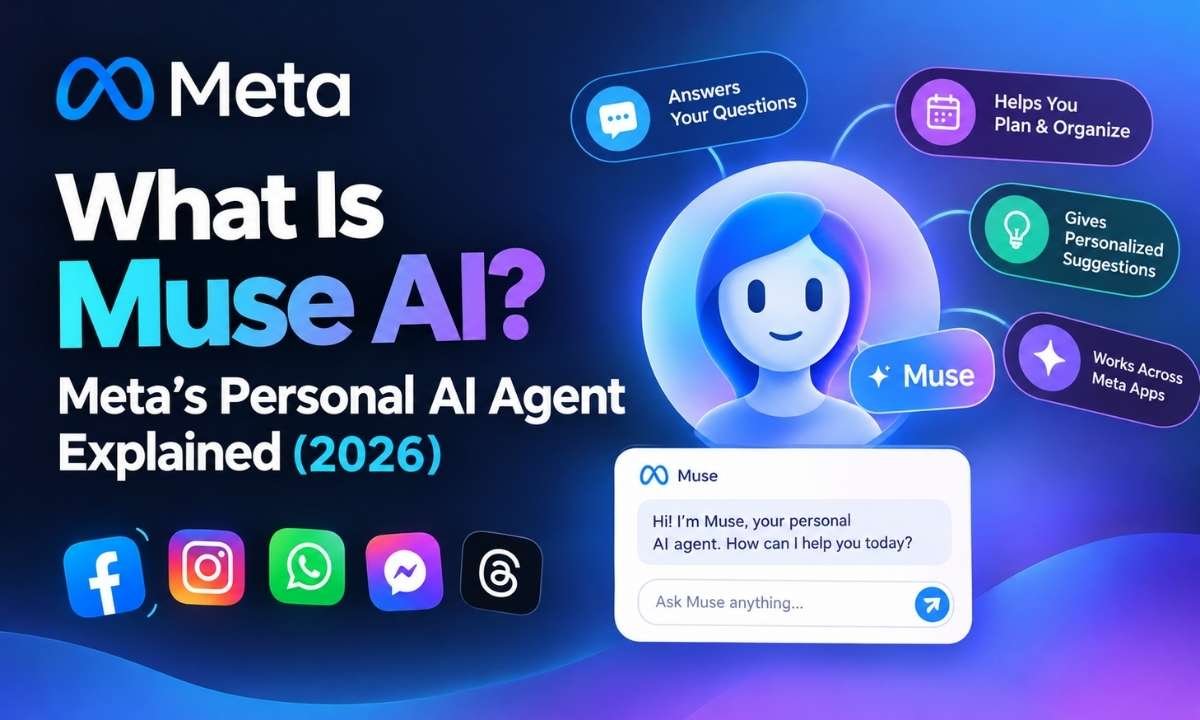
Muse AI is Meta’s personal AI agent, introduced on September 8, 2026. It takes tasks off your plate by sending emails, booking travel, shopping and planning goals, and it asks for your approval before any sensitive step.
This guide explains what Muse is, how the app and agent work, what the model family adds, what it costs and whether India gets it. It draws on Meta’s launch documents and independent reporting, and flags single source claims.
What Is Muse AI?
Muse is a consumer AI agent built by Meta Superintelligence Labs, the unit led by chief AI officer Alexandr Wang. Meta says it proactively helps with your goals and suggests ideas, rather than waiting for a prompt each time.
The agent runs on Muse Spark 1.3, Meta’s most capable model so far. You talk to it in the Muse app, at muse.ai or through WhatsApp, much like messaging a person who has access to your apps.
The name causes confusion because Meta uses “Muse” for two things at once. One is a family of AI models. The other is the app you install. Think of the model as the engine and the app as the car.
| Name | What it is |
|---|---|
| Muse | The personal AI agent app |
| Muse Spark | Meta’s flagship model, the engine behind the app |
| Muse Glimmer | A smaller open weight model for developers |
| Muse Code | A coding agent released in beta |
| Muse Charm | An announced keychain device, no release date |
What Is the Muse AI App?
The Muse app is the front door to the agent. Meta says it is rolling out in the US on iOS and Android, and the agent also lives at muse.ai. US users can message it in WhatsApp too.
You must be 18 or older. You can give your agent a custom name and avatar, a deliberate choice by Meta so that people would not feel they were chatting with a corporate logo or entity.
Early adoption was fast. One report put downloads above 3.4 million within weeks of launch. That figure comes from a single outlet, so treat it as an early signal rather than a confirmed milestone for now.
Setup is short, and most first sessions follow the same pattern. You sign in, connect the services you want, describe a goal and review the plan. The numbered steps below show the order in more detail.
- Open the app or muse.ai and sign in.
- Connect only the apps you want Muse to use, such as email or calendar.
- Choose how much access each app gets, for example read only or read and send.
- Describe a goal in plain language.
- Review the plan and approve sensitive actions when Muse asks.
What Is a Muse AI Agent?
An AI agent is software that carries out tasks instead of only replying. A chatbot answers a question about flights. An agent finds the flights, fills in the booking form and returns to you for approval before paying.
Meta built Muse to work for billions of people, so the pitch is simplicity. You do not write prompts like an engineer. You state what needs to happen, and Muse builds a plan and coordinates your time and resources.
Muse keeps working after you close the app. When something changes or a decision needs you, it comes back with a prompt. Meta says it checks with you before actions such as sending an email or making a purchase.
Muse also remembers context. It can turn a recipe reel you saved on Instagram into a grocery list, or recall a friend’s dietary restriction before drafting dinner invitations. You can tell it to forget specific things.
Nat Friedman, who leads product at Meta Superintelligence Labs, said on September 21 that Muse was built from scratch but is heavily inspired as a product by OpenClaw, an existing agent project. That candor helps explain the design.
How Muse Secure VM Works
Each Muse runs on its own dedicated cloud computer called Muse Secure VM. The virtual machine holds the agent, your connected data and your credentials, and it is isolated so that another person’s agent cannot reach it.
A separate Sentinel agent runs on the same machine, kept apart from Muse at the system level. Nothing Muse does reaches the internet unless the Sentinel approves it, and the Sentinel asks you whenever permission is needed.
Muse cannot see your passwords or payment methods. Credentials you share go into secure storage that Muse can use without reading. It also cannot see passwords you type into its browser yourself, so logins you type stay private.
What Meta Says About Your Data
- Meta uses Muse interactions to train its AI models unless you opt out.
- Meta says your conversations and VM data are not shared with its ad systems.
- You get an audit trail of what Muse has done and plans to do.
- You can change access or disconnect any service whenever you want.
SiliconANGLE reported that a Meta executive told Wired the company’s policies bar it from looking inside your VM, though it could technically do so. Meta plans a Muse Confidential VM later this year, encrypted with your own key.
Muse AI Meta: How Meta Built It
Meta formed Meta Superintelligence Labs to rebuild its AI work, and it hired Alexandr Wang from Scale AI after a reported 14.3 billion dollar investment in that company. The first public result was Muse Spark, released on April 8, 2026.
Muse Spark is a natively multimodal reasoning model with tool use, visual chain of thought and multiagent orchestration. It powers the Meta AI assistant in its app and on meta.ai, and Meta began extending it to social apps.
Updates came quickly. Muse Spark 1.1 launched on July 9, and version 1.3 followed on September 2, according to Wikipedia’s model page. Meta also released Muse Glimmer, a smaller open weight model, on August 10.
Muse Code, a coding agent, entered beta on August 5. Meta has also expanded the family with Muse Image and Muse Video, so the Muse name now spans both language and visual work, including code.
This marks a shift in strategy. Earlier Llama models were open weight, while Muse Spark is proprietary. Wang has said Meta delayed shipping the Muse agent for several months to focus on safety and security.
Muse Spark: The Model Behind the App
Muse Spark is the reasoning engine, and its design explains what the agent can do. Meta calls it small and fast by design, in its own words, yet capable of working through hard questions in science and math.
Wikipedia lists a context window of one million tokens, which lets the model hold long documents and extended tasks in memory. For an agent that works across many steps, that capacity matters more than raw speed.
The model also offers a Contemplating mode that Meta says is meant to compete with the extreme reasoning modes of rival systems. Meta announced at launch that this mode would roll out gradually on meta.ai.
On health, Meta says it worked with more than 1,000 physicians to curate training data. Muse Spark can respond to health questions that include images and charts, though you should treat any answer as information, not diagnosis.
Meta Muse AI App vs Meta AI
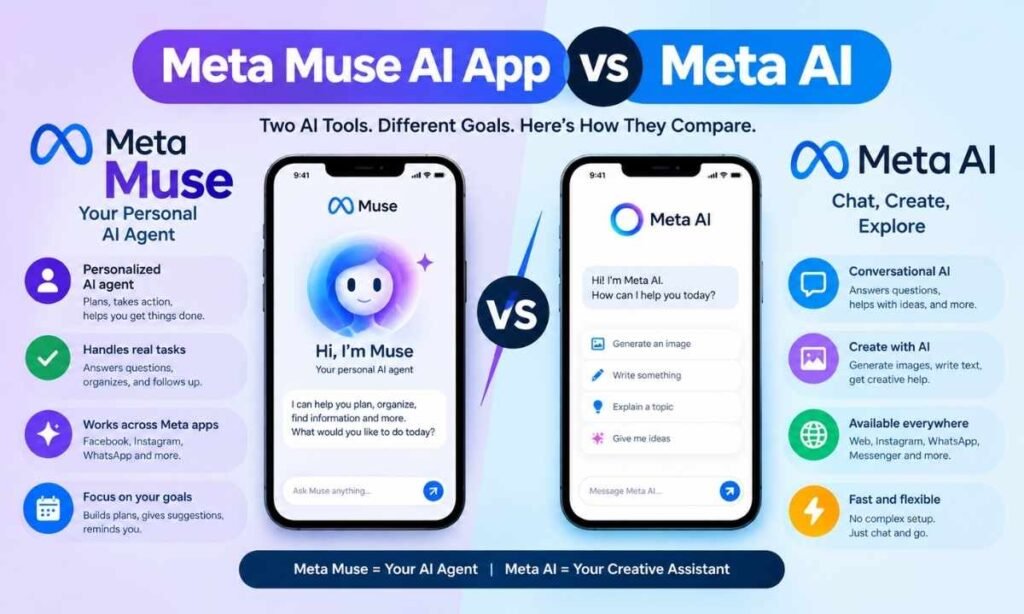
Meta AI is the assistant already built into Meta’s apps, and it mostly answers questions. Muse is a separate agent that acts, keeps working in the background and asks for approval. Its rollout is far narrower.
| Feature | Meta AI | Muse |
|---|---|---|
| Main job | Answers questions | Completes tasks |
| Where | Meta apps, meta.ai | Muse app, muse.ai, WhatsApp |
| Background work | No | Yes |
| Model | Muse Spark | Muse Spark 1.3 |
| Availability | Wide, includes India | US and Canada |
Meta’s launch post names only the US, and later reports add Canada. Check the Muse help center for the current country list before you plan around it, because Meta describes the rollout as limited testing.
What Does Muse AI Do?
Muse handles errands and long projects. Meta’s own examples include selling a car for more, lowering a bill and adjusting a training plan as the rest of your life shifts. It can also negotiate on your behalf.
These are the tasks Meta and outside coverage describe most often. Each one runs only with the app access you grant, and sensitive steps wait for your approval before anything is sent or bought on your behalf.
- Sending emails and managing calendar items after you approve
- Booking travel
- Shopping and checking out through Link by Stripe
- Opening a browser and filling out forms
- Turning a long goal into a plan and tracking it
Payments run through Link by Stripe, and Muse is the first AI agent covered by its purchase protections. Cover includes damaged or lost items and price drops, plus no fee returns. A one time card hides your real card.
On September 29, Meta added Muse for Small Business. It bundles skills and connectors so owners can plan content, improve ads, review sales and follow up with customers. Meta ad accounts and Facebook Pages connect in a few clicks.
Shop Pay and 1Password support are listed as coming soon, so Muse could use logins you already store. Meta also plans AI glasses support, though it has not shared a date for that launch yet.
Muse AI at Meta Connect 2026
At Connect in late September, Mark Zuckerberg announced new capabilities and integrations for Muse, according to TechCrunch. The stated aim is for Muse to be available wherever you choose, including on Meta’s AI glasses if you own a pair.
The agent can connect to email and calendars, and Meta says you decide which apps it reaches. Meta also describes Muse as accessible to people with little technical experience, which is its main pitch against other agents.
Muse Charm is the other hardware idea. It is a keychain sized handheld device that runs the agent without unlocking a phone or opening an app. Meta has not announced a release date for the device yet.
Muse AI Pricing
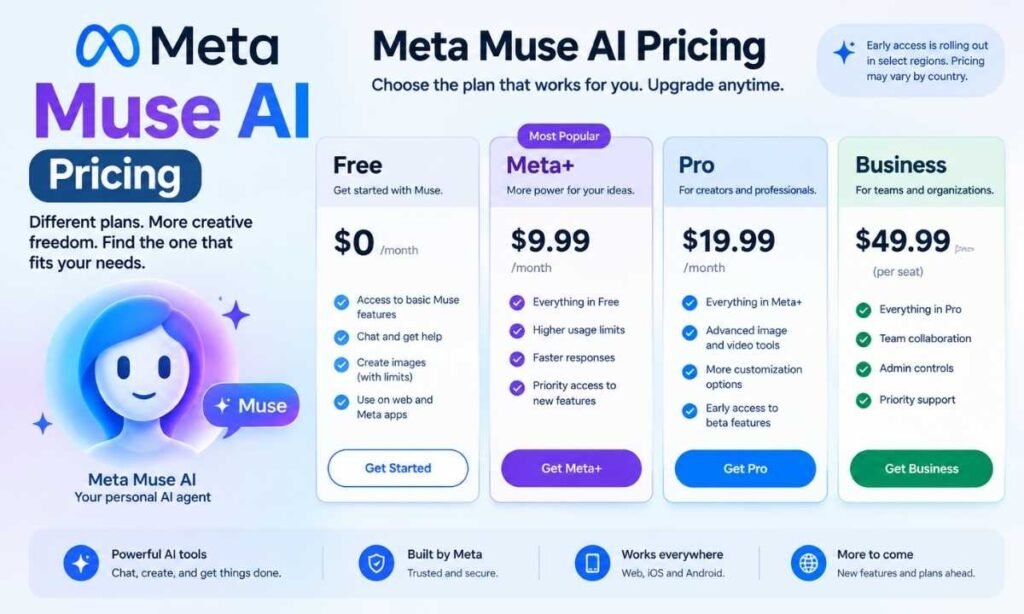
Muse is free for most everyday use, with a weekly limit that refreshes. Paid plans do not unlock extra features. They raise your weekly usage, which Meta counts in Muse tokens instead of completed tasks.
| Plan | Price | Weekly tokens |
|---|---|---|
| Free | $0 | Limit not published |
| Power | $20 a month | 500 million |
| Max | $100 a month | 3 billion |
Both paid plans carry the same features. Max gives six times the usage for five times the price. Subscriptions renew monthly on your purchase date, and Meta says benefits and availability may vary by region and account.
Because tokens measure compute, one long background project can use more than dozens of quick questions. Watch your meter during the first week before you pay for anything. A Muse subscription does not include API access.
One third party guide reports that the free plan asks for a card, and that running out of free tokens pauses the agent instead of billing you. Meta’s help center is the place to confirm that.
Is Muse AI Available in India?
No. Muse is not available in India, and Meta has not given a date. Reports say access is limited to the United States and Canada, and the app is not listed on the Indian App Store.
This surprises people because India was Meta AI’s top market by app downloads, according to Appfigures data reported in April. But Meta AI and Muse run on separate rollouts, so having one does not mean you can use the other.
Some online guides suggest a US VPN. Meta’s terms say you must be physically located in a country where Muse operates, so that route risks your account. Shopping and payment features also work only for US users for now.
What can Indian users do today while they wait? The options are limited, and none of them gives you the full Muse agent. Here is what Meta’s own products and developer routes allow right now.
- Use Meta AI in WhatsApp, Instagram and Facebook
- Developers can call Muse Spark 1.3 through OpenRouter, which gives model access but not the Muse agent
- Watch for the in-app message that says Meta will notify you when Muse reaches your region
Meta says Muse will reach more countries over time but has confirmed no date for India. Until it does, treat any claim of official Indian access as unverified, and check Meta’s help center for updates.
Trump and Artificial Intelligence: What “The Enemy” Searches Point To
Trump has not called AI the enemy in the coverage reviewed here. In mid September 2026 he dismissed warnings that AI could threaten humanity as a hoax and framed AI as a race the United States must win against China.
On Monday, September 14, he posted that AI needs no guardrail beyond a strong president and called opposition to AI a “sick conspiracy.” AP said he answered oversight calls from tech leaders such as Dario Amodei and Sam Altman.
He also praised data centers as the oil of the next two decades. None of the coverage found links these remarks to Meta or Muse, so the overlap is context only, while US AI policy stays a live political topic.
OpenAI Math: Why It Appears Beside Muse
OpenAI’s math results are a separate story, though readers compare them with Muse Spark’s reasoning claims. On May 20, 2026, OpenAI said a general reasoning model disproved an Erdős conjecture on the planar unit distance problem, posed in 1946.
On August 1, OpenAI published ten results in mathematics and theoretical computer science from an internal Astra model, each with a Lean 4 proof certificate. Compute reportedly cost about $2,000, and by September 1 none had cleared peer review.
Muse Spark competes in the same reasoning race with less public math evidence. Meta pitches it for complex reasoning in science and math. No source found for this article shows Muse solving open research problems.
As of October 5, Muse Spark 1.3 ranked seventh on an independent leaderboard cited by Real Python, scoring 48 against the leader’s 58. That makes it competitive, though not dominant, and the gap may shift with each model update.
Muse AI Strengths and Limits
| Strength | Limit |
|---|---|
| Acts across your apps | US and Canada only |
| Approval before sensitive actions | Free cap, size unpublished |
| Isolated Secure VM | Trains on chats unless you opt out |
| Full audit trail | Meta says it will make mistakes |
Meta itself says Muse will sometimes make mistakes. That is why approval prompts and the audit trail matter more than any feature list. Review each plan before you approve it, especially any step that spends money.
How to Get Better Results From Muse
Start with low risk tasks, such as a grocery list or a trip outline, so a mistake costs you nothing. Once the plan quality looks reliable, move to tasks that send messages or spend money.
Grant the narrowest access that works. For email, begin with read only and add sending later once you trust the results. Meta says you can change or disconnect any service whenever you want, so nothing is locked in.
Give goals a deadline and a limit, such as a budget or a preferred date range. Specific instructions leave Muse less to guess, which should reduce the number of approval prompts you need to answer.
Open the audit trail after every long project. It shows what Muse did and what it plans next, which is the fastest way to catch a wrong assumption before it repeats across many later tasks.
Who Should Use Muse AI?
Muse suits people in supported countries who lose time to errands, shopping, scheduling and follow ups. It also suits small business owners who run Instagram or Facebook pages and want help with content and ads.
Skip it for now if you need unlimited free use or live outside the US and Canada. If you handle highly sensitive records, wait for the Confidential VM that Meta promised before trusting Muse with them.
Frequently Asked Questions
What is Muse AI?
Muse AI is Meta’s personal AI agent, launched September 8, 2026, that completes tasks across your apps and asks approval before sensitive actions.
What is a Muse AI app?
It is Meta’s agent app for iOS and Android, also reachable at muse.ai and through WhatsApp for US users.
What is a Muse AI agent?
It is an agent that plans and acts for you, such as sending emails or booking travel, and keeps working after you close the app.
What is Muse AI Meta?
Muse is both Meta Superintelligence Labs’ model family and its agent app. Muse Spark is the model that powers the app.
What does Muse AI do?
It handles errands and goals, including email, travel, shopping, forms and planning, and checks with you before sensitive steps.
Is Muse AI free?
Yes, with a weekly usage limit. Power costs $20 a month and Max costs $100 a month for more usage.
Is Muse AI available in India?
No. Muse is limited to the US and Canada, and Meta has not announced an India date.
Is Muse the same as Meta AI?
No. Meta AI mostly answers questions inside Meta apps, while Muse is a separate agent that completes tasks.
Is Muse AI safe?
Meta built Secure VM, a Sentinel agent and approval prompts. It still trains on interactions unless you opt out, so review your settings.
Did Trump call AI the enemy?
Not in the coverage reviewed. He called AI danger warnings a hoax and described AI as a race against China.
Did OpenAI solve math problems with AI?
OpenAI reported solving a famous conjecture in May 2026 and ten more problems in August, but peer review is still pending.
What is Muse Spark?
Muse Spark is Meta’s multimodal reasoning model, released April 8, 2026, which powers both Meta AI and the Muse agent.
Conclusion
Muse AI is Meta’s attempt to move AI from answering questions to doing the work. Its Secure VM, approval prompts and audit trail are the main reasons to consider it, and its limits are regional access and a usage cap.
If you live in the US or Canada, start with the free tier and low risk tasks. If you are in India, use Meta AI for now and watch Meta’s help center for any official Muse announcement.