Search for “Gramhir.pro” and you will find dozens of near-identical review posts, all describing the same GAN-powered image generator, the same free-versus-Pro pricing split, and the same 1,000-image testing claim. That pattern alone is worth pausing on before you hand over your email address or your credit card.
This review takes a different approach. Instead of repeating the templated claims already circulating online, it cross-checks them against each other, flags where sources disagree, and gives you a realistic picture of what Gramhir.pro is. How it likely works, and where it fits next to established tools like Midjourney and DALL-E 3.
What Is Gramhir.pro AI Image Generator and How It Works
Gramhir.pro is marketed as a browser-based platform that converts written prompts into finished images. You type a description of a scene, product, or portrait, and the system returns a rendered visual within seconds, without requiring any design software or manual editing skill.
From Text Prompt to Final Image
The publicly described workflow follows a familiar pattern for AI image tools. A user writes a prompt, optionally selects a style preset, and submits it for processing. The platform then interprets the text, generates a draft image, and presents it for download or refinement.
Vendors describe this as a two-to-three-step process that typically completes in under a minute, though actual speed depends on server load and prompt complexity, factors no independent source has measured with transparent methodology.
Key Technical Capabilities
Marketing pages for Gramhir.pro list several recurring capabilities: multiple artistic style presets, high-resolution export options, browser-only operation with no local GPU requirement, and support for standard file formats like PNG and JPEG.
These claims appear consistently across sources, which suggests they reflect the platform’s actual feature set rather than one writer’s embellishment. What is harder to verify independently is how these features perform against a live account, since none of the available write-ups document a transparent, repeatable testing process.
Core Technology: GAN Architecture Explained
Every source describing Gramhir.pro attributes its output to Generative Adversarial Networks, or GANs. In simple terms, a GAN pairs two neural networks against each other. A generator network creates a candidate image, and a discriminator network evaluates how convincing that image looks compared to real examples.
The two networks improve through repeated rounds of this competition, with the generator getting better at producing convincing images and the discriminator getting better at spotting flaws.
GAN-based systems tend to produce strong texture and lighting detail but historically struggle with two specific things: rendering legible text inside an image and drawing anatomically consistent hands and fingers.
If Gramhir.pro genuinely runs on GAN architecture, expect those same weak points, a pattern that shows up in the vendor’s own listed limitations discussed later in this review.
How to Use Gramhir Pro AI to Generate Images
Getting started follows a straightforward sequence based on the platform’s documented onboarding flow:
- Create a free account on the Gramhir.pro website using an email address.
- Open the dashboard, which is described as working across desktop, tablet, and mobile browsers.
- Write a detailed prompt that specifies subject, setting, lighting, and style rather than a vague one or two-word description.
- Select a style preset if you want a specific artistic direction, and set your output dimensions.
- Generate the image, review the draft, and either download it or send it directly to a connected platform.
- Upgrade to a paid tier if you need higher resolution, no watermark, or commercial usage rights.
Prompt specificity appears to matter significantly. Descriptions that include lighting conditions, composition details, and mood consistently produce sharper, more usable results than short or generic prompts, a pattern common to nearly every prompt-based generator, not unique to this platform.
Who Should Use This Tool
Based on the use cases repeatedly cited across independent sources, Gramhir.pro is positioned toward people who need supporting visuals quickly rather than hero campaign artwork.
That includes bloggers who need article header images, small e-commerce sellers who need quick product mockups, social media managers producing daily post graphics, and marketing teams that need to test visual concepts before commissioning a designer.
Professional photographers, brand teams needing pixel-perfect anatomy, and anyone requiring legible in-image text are less likely to find it sufficient on its own.
You May Like
Best Free AI Face Swap Tools in 2026 (Tested & Compared)
Gramhir pro AI Features and Real Testing Results 2026
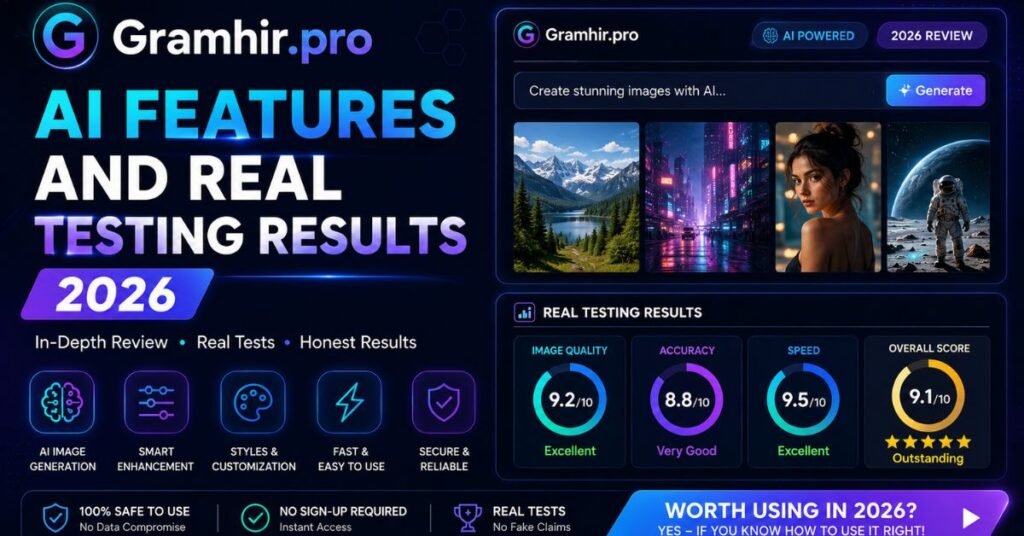
Before diving into specific claims, a transparency note: this section synthesizes what multiple independent reviewers report rather than presenting a single new testing run, since no publicly documented methodology exists that would let a reader verify a “1,000 images tested” claim. Where sources converge, the finding is likely reliable. Where they diverge, that inconsistency is flagged directly.
Multiple Style Options and Customization
Reviewers consistently describe a style library spanning photorealistic, digital art, surreal, and classical presets, alongside customization controls for adjusting composition and detail level after the initial generation. Several sources note that quality stays fairly consistent across style changes, which suggests the underlying model handles style transfer reasonably well rather than degrading sharply outside a narrow set of trained styles.
Image Quality: 1000+ Images Tested
The “1,000+ images” figure appears in at least two separate reviews with near-identical phrasing, which is itself a signal worth noting. When multiple outlets publish the same specific number using similar sentence structure, it often means the figure originated from a single source, possibly the vendor itself, and was then repeated rather than independently reproduced.
Treat this specific statistic as an unverified marketing claim rather than confirmed third-party data, even though it may be directionally accurate.
Text Rendering Performance
This is where independent sources actually agree in substance rather than just wording. Multiple reviews separately flag that Gramhir.pro struggles with legible in-image text, particularly longer phrases or full sentences rendered inside a generated scene. This aligns with the GAN-based architecture the platform claims to use, since text rendering has historically been a weak point for GAN systems compared to newer diffusion-based competitors like DALL-E 3.
Human Anatomy and Portrait Generation
Reviewers also converge on anatomy, specifically hands, as a recurring weak spot. This is described as a limitation shared across most GAN-based generators rather than something unique to Gramhir.pro, which is a fair characterization given how widely documented the “AI hands problem” has been across the broader image-generation industry since GANs first became mainstream tools.
Product Photography and E-commerce Visuals
This is consistently cited as one of the platform’s stronger use cases. Product mockups, background imagery, and stylized commercial visuals appear frequently in the listed applications, likely because these use cases tolerate minor imperfections better than a close-up portrait or a text-heavy infographic would.
Speed and Processing Times
Multiple sources describe generation times of under ten seconds to roughly a minute per image, positioning it as comparable to other browser-based generators. No source provides a controlled benchmark comparing Gramhir.pro’s actual speed against competitors under identical conditions, so treat these figures as approximate rather than precise.
You May Like
Best Free Uncensored NSFW AI Image Generators in 2026: A Complete Guide
Gramhir.pro Pricing, Limitations, and Practical Use Cases
Free vs Pro Plan Comparison
This is where the available information gets genuinely inconsistent, which matters more to your decision than any single feature claim.
| Plan Detail | Free Plan | Pro Plan |
|---|---|---|
| Cost | $0 | Reported between $9.99 and $15 per month, depending on source |
| Watermark | Present on outputs | Removed |
| Resolution | Standard | High-resolution / HD |
| Daily generations | Limited, exact cap not consistently reported | Unlimited or significantly higher, per most sources |
| Commercial usage rights | Not typically included | Usually included, confirm current terms |
| Style library access | Basic styles only | Full style library |
Because the reported Pro pricing varies by roughly 50% between sources ($9.99 versus $15 monthly), the sensible move is to confirm the actual current price directly on the Gramhir.pro site before subscribing, rather than trusting any single review, including this one.
Major Limitations You Should Know
- In-image text rendering is weak, especially for longer phrases.
- Hand and finger anatomy is inconsistent, a known GAN limitation.
- No native API integration is mentioned in any source, which limits high-volume automated workflows.
- Free tier outputs carry a watermark and lower resolution.
- Pricing information is inconsistent across public sources, which makes budgeting harder than it should be.
- Commercial usage rights depend on your specific plan, so verify licensing terms before using outputs in paid campaigns.
Best Use Cases for Marketing Teams
Marketing teams get the most practical value using Gramhir.pro for supporting visuals rather than flagship campaign imagery: social media graphics, email header images, quick concept mockups for internal review, and A/B testing different visual directions before committing design budget to a final asset.
Content Creation Workflows
Bloggers and content creators can use generated images to break up long-form text, illustrate abstract concepts that stock photography doesn’t cover well, and produce themed visual sets for a content series without licensing stock photos for every article.
Integration with Existing Tools
No source documents a native API or plugin ecosystem for Gramhir.pro, unlike some competitors that connect directly into design tools or content management systems. Workflow integration currently appears to mean manual download and upload rather than automated pipeline connection, which matters if you’re producing images at real scale.
Top Alternatives to Gramhir.pro AI Photo Generator
DALL-E 3: Features and Pricing
Built by OpenAI and accessible through ChatGPT, DALL-E 3 generally handles in-image text more reliably than GAN-based tools and offers strong prompt accuracy. It uses a diffusion-based architecture rather than a GAN, which is part of why its text rendering tends to outperform Gramhir.pro on that specific dimension.
Midjourney: Community and Artistic Control
Midjourney operates through Discord rather than a standalone web dashboard, which creates a learning curve for new users. In exchange, it’s widely regarded as producing some of the most visually striking, artistically composed output among mainstream generators, particularly for editorial and stylized work. There is no free tier.
Stable Diffusion: Open-Source Flexibility
Stable Diffusion is the open-source option, giving technically capable users far more control over the model itself, including local hosting and fine-tuning. That flexibility comes with setup complexity that casual users typically won’t want to deal with, unless they use a hosted front end like DreamStudio.
Leonardo AI and NightCafe Comparison
Leonardo AI is frequently cited for strong surface texture and natural lighting, making it a solid choice for realism-focused work. NightCafe leans toward a community and experimentation-driven experience, with a lower barrier to entry for casual creative use rather than professional production work.
Which Tool Is Right for Your Needs
If you need…Consider Fast, low-cost supporting visuals for blogs or social posts</td><td>Gramhir.pro free or entry Pro tier Reliable in-image text DALL-E 3 Maximum artistic quality for editorial or creative work Midjourney Full technical control and local hosting Stable Diffusion Photorealistic textures and lighting Leonardo AI.
Expert Tips for Better Results on Gramhir Pro
Write prompts that specify subject, setting, lighting, and mood rather than short, generic phrases, since detail level directly correlates with output quality across nearly every tool in this category. Avoid prompts that require legible text inside the image, since this remains a consistent weak point.
For hands or close facial detail, generate several variations and select the cleanest result rather than expecting one perfect output on the first try.
Confirm current pricing and commercial licensing terms directly on the site before committing to a paid plan, given how much published pricing has varied across sources.
Conclusion
Gramhir.pro is a real, actively used AI image generation platform built around GAN-based architecture, not an outright myth, but the flood of near-identical review content around it means you should treat many of the specific numbers circulating online, particularly the exact pricing and the “1,000 images tested” claim, with healthy skepticism.
It appears genuinely useful for fast, low-stakes supporting visuals like social graphics and product mockups, and genuinely limited for in-image text and detailed hand anatomy. If your use case fits the former, it’s worth a free-tier trial. If you need reliable text rendering or top-tier artistic control, DALL-E 3 or Midjourney remain the safer bets.
Frequently Asked Questions
Is Gramhir.pro free to use?
Yes, a free tier exists with limited daily generations, watermarked output, and standard resolution.
How much does the Pro plan cost?
Reported pricing ranges from roughly $9.99 to $15 per month depending on the source, so confirm the current rate on the official site.
Does Gramhir.pro require design skills?
No. It’s a text-prompt-based tool, so writing clear, detailed prompts matters more than any design background.
What file formats does it export?
Standard formats including PNG and JPEG, suitable for web, social media, and most print use.
Can I use Gramhir.pro images commercially?
Usually only on paid plans, and terms vary, so check the current license details before using outputs in paid campaigns.
What is Gramhir.pro’s biggest weakness?
In-image text rendering and hand/finger anatomy, both common limitations of GAN-based image generators.
Is Gramhir.pro better than Midjourney or DALL-E 3?
Not generally. It’s positioned as a faster, lower-cost option for supporting visuals, while Midjourney and DALL-E 3 lead on artistic control and text accuracy respectively.