
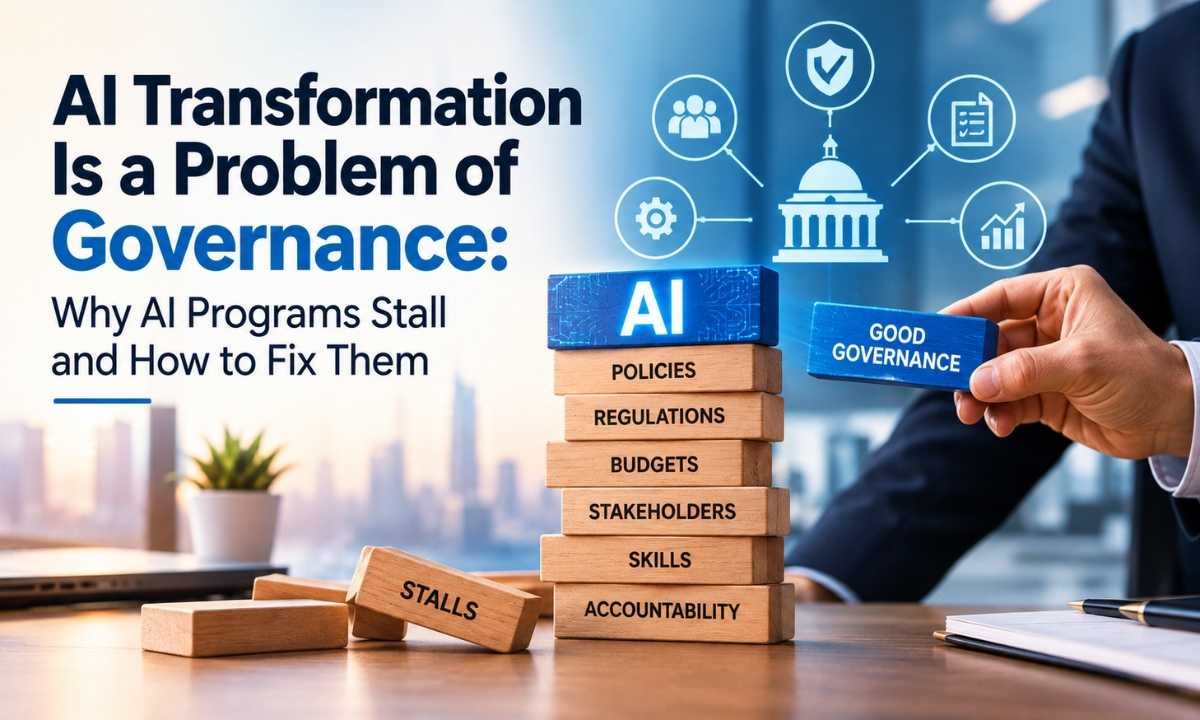
Most companies that struggle with AI did not pick the wrong model. They never settled who approves a system, and who answers when it fails. That gap explains why AI transformation is a problem of governance before it is a problem of technology.
This guide explains what AI governance means in practice and where transformation programs break. It also covers shadow AI, agent oversight, the regulatory calendar as of late 2026, and a 90-day starting plan. Everything here is written for leaders who must decide, not just understand.
Key Takeaways
- Most AI programs stall because decision rights, ownership, and risk limits were never defined, not because models underperform.
- Governance is the operating system for AI. It assigns approval, accountability, monitoring, and shutdown authority.
- Shadow AI and agentic systems are two of the fastest growing exposures in 2026.
- The EU AI Act’s high-risk deadlines moved to December 2027 and August 2028, yet other duties already apply.
- Governance alone is not enough. Skills, data quality, and workflow design matter as well.
What Does It Mean When We Say AI Transformation Is a Problem of Governance?
It means the hardest part of adopting AI is deciding how an organization will behave once machines influence its decisions. Models are available to everyone. Rules about data use, approvals, accountability, and escalation are not, and they determine whether a pilot becomes a dependable business capability.
Consider a customer-support assistant that drafts refund offers. The model may work perfectly. Yet nobody has decided the refund limit it may propose or who reviews exceptions when a customer disputes the outcome. Those unanswered questions, not the code, stop the launch.
Survey data points the same way. McKinsey’s 2025 State of AI research found that 39 percent of organizations reported any enterprise-level EBIT impact from AI. Adoption is widespread, but measurable value is not, and the difference usually traces back to management structure rather than model quality.
Technology Problem or Governance Problem? A Quick Diagnostic
| What you see | What it looks like | What it usually is |
|---|---|---|
| Pilot never ships | Weak model | No approval path |
| Inconsistent outputs | Model flaw | Unowned, messy data |
| Staff avoid the tool | Poor design | Unclear rules, low trust |
| Surprise bills | Pricing issue | No usage limits |
| Audit scramble | Paperwork burden | No records kept |
What Is AI Governance?
AI governance is the set of policies, roles, decision rights, and controls an organization uses to manage AI from idea to retirement. It answers who may build or buy a system, what data it may touch, how it is tested, and who monitors it afterward.
People often confuse three related terms. Responsible AI states principles such as fairness and transparency. Compliance proves you meet specific laws. Governance is the working machinery that turns principles into daily behavior and produces evidence that compliance teams and regulators can inspect.
| Concept | What it does | Typical artifact |
|---|---|---|
| Responsible AI | Sets values | Published principles |
| Compliance | Proves legal fit | Audit records |
| Governance | Runs controls daily | Model register, approvals |
Why AI Transformation Stalls Without Governance
The Gap Between Pilot and Production
Pilots are forgiving. A small team, a narrow dataset, and a friendly audience hide most risks. Production removes that protection. Real customers, messy data, security reviews, and legal scrutiny arrive together, and teams without agreed rules discover problems one meeting at a time, often right before launch.
Leaders sometimes read this delay as technical immaturity and respond by funding more experiments. That usually makes things worse. Each new pilot adds another unmanaged system, another data flow, and another owner who may leave. Fragmentation grows faster than value, and the cost of cleaning it up rises every quarter.
AI Changes Who Makes Decisions
Traditional software follows rules someone wrote. AI systems infer, rank, recommend, and sometimes act. That shifts judgment from named employees to statistical models, which means authority has moved without anyone formally approving the move. Governance is how an organization decides that shift deliberately instead of by accident.
Hiring screens, credit limits, claims triage, and pricing recommendations all carry this pattern. A human may still click approve, but if the click happens in two seconds on a ranked list, the model made the decision. Governance asks whether that human review is real or ceremonial.
Ownership Falls Between Departments
IT owns the platform, data teams own the pipelines, legal owns the risk, and the business owns the outcome. When an AI system misfires, each group can reasonably say the problem sits elsewhere. Without a named accountable executive, incidents become negotiations instead of responses.
What Failure Looks Like: An Illustrative Scenario
Picture a mid-sized insurer that launches a claims-triage model. Accuracy tests look excellent. Three months later, adjusters notice that certain claim types are routed to slow queues. Nobody owns the model, the vendor retrained it twice, and no one kept baseline results for comparison.
This is a composite example, not a real case, but the pattern is common. The fix would not be a better algorithm. It would be an owner, a baseline, a change notice clause, and a monthly review. All four are governance decisions, and none needs new technology.
Seven Governance Failures That Quietly Sink AI Programs
| Failure | Symptom | First fix |
|---|---|---|
| Shadow AI | Staff paste data into unapproved tools | Approved list, fast request path |
| Tool sprawl | Teams buy overlapping licenses | Central intake and register |
| Orphaned models | Owner left, nobody watches drift | One named owner per system |
| Weak data lineage | Training sources cannot be traced | Provenance records |
| Vendor blind spots | Supplier changes a model silently | Change notice in contracts |
| Uncapped spend | Usage costs spike after launch | Budgets, rate limits, alerts |
| No off switch | A faulty system keeps running | Named shutdown authority |
Use this table as a quick audit. If you recognize more than three rows in your own company, governance is the bottleneck, and adding another pilot will not help. The sections below take the most damaging rows one at a time.
Shadow AI: Your Biggest Blind Spot
Shadow AI means employees using AI tools the company has not approved. They are rarely malicious. They want faster drafts and analysis, and the official option is slow or missing. The risk is that confidential data or customer details leave controlled systems unnoticed.
Banning tools rarely works, because people simply move to personal devices. A better approach publishes an approved list, offers a fast request path for new tools, and explains plainly what data may never be pasted into any external system. Visibility beats prohibition.
Vendor and Third-Party Risk
Most companies consume AI through suppliers, which creates a quiet dependency. A vendor can update a model or change a data policy without asking. Your system’s behavior then changes while your own code stays the same, and nobody on your side may notice.
Contracts should require advance notice of material model changes, clarity on whether your data trains their models, incident reporting timelines, and audit rights proportionate to risk. Ask for these before signing, since your bargaining power fades quickly once the system is live and embedded.
Cost Without Control
AI spending behaves differently from traditional software. Usage-based pricing means a popular feature or a looping agent can multiply a bill overnight. Finance teams rarely see this until the invoice lands, so budgets, rate limits, and usage alerts belong inside the governance design from the start.
Governing Agentic AI: When Systems Act on Their Own
Chat assistants answer questions. Agents take actions such as sending emails, updating records, approving transactions, or calling other software. The governance question changes from whether the answer is accurate to whether the action was permitted. Many existing policies were written for the first problem and say nothing about the second.
Treat an agent like a new employee with a very fast keyboard. Give it a defined role, the narrowest permissions that allow the job, a spending limit, and a supervisor. Log every action it takes. Define the conditions that force it to stop and ask a human.
- Identity: each agent has its own credentials, never a shared admin login.
- Permissions: read-only by default, with write access granted per task.
- Limits: caps on spend, volume, and irreversible actions.
- Logging: complete action records retained for audits.
- Escalation: defined triggers that route decisions to a person.
- Kill switch: one named person who can pause the agent immediately.
Test these controls before launch with deliberate failure drills. Ask what happens if the agent receives a malicious instruction hidden in an email or loops endlessly on one task. Teams that rehearse failure write better limits than teams that only imagine success.
Data Governance Decides Whether AI Output Can Be Trusted
AI inherits the strengths and flaws of its data. If customer records are duplicated or access rules are unclear, the model will amplify those flaws at speed. Many AI failures that look like model errors are data governance failures wearing a different label.
Practical data governance for AI starts with provenance: where the data came from and what purpose it may serve. Add quality checks, retention limits, and a record of which datasets fed which systems. When a regulator or customer asks why a result occurred, you can answer.
Governance Is Necessary but Not Sufficient
Calling this purely a governance problem oversimplifies. Governance sets direction and limits, yet it cannot supply skills, clean data, or redesigned workflows. A company with excellent policies and untrained staff will still see weak adoption. Governance is the frame, and capability is what fills it.
The opposite error is just as costly. Some organizations build heavy approval committees that treat every chatbot like a medical device. Teams then route around the process, shadow AI grows, and the governance body loses credibility. Proportionality matters: light controls for low-risk uses, deep review only where harm is plausible.
People and Culture: The Part Policy Cannot Fix
Employees follow incentives, not binders. If staff are praised for speed and punished for asking permission, they will bypass controls. Leaders must make the compliant path the easy path, with quick approvals and clear answers, and must reward people who report problems early.
Training matters too, but generic awareness videos do little. Teach role-specific rules, such as what a recruiter may paste into a tool and how an analyst should verify generated figures. Short, concrete guidance changes behavior more than long policy language. Repeat it when tools change.
AI Regulation in 2026: What Applies and What Moved
The EU AI Act remains the most detailed binding framework. Prohibited practices applied from February 2025, and obligations for general-purpose AI models began in August 2025. In July 2026, the Digital Omnibus entered into force and pushed back the high-risk deadlines. That is a delay, not an exemption.
| Milestone | Date | Status |
|---|---|---|
| Prohibited practices | 2 Feb 2025 | Applying |
| General-purpose AI duties | 2 Aug 2025 | Applying |
| Annex III high-risk systems | 2 Dec 2027 | Moved from Aug 2026 |
| Embedded high-risk systems | 2 Aug 2028 | Moved from Aug 2027 |
Outside the EU, voluntary frameworks carry real weight. The NIST AI Risk Management Framework, released in January 2023, organizes risk work into govern, map, measure, and manage functions. ISO/IEC 42001, published in December 2023, defines a certifiable AI management system that auditors and customers increasingly recognize.
Rules differ by country and by US state, and they change often. Treat any summary, including this one, as a starting point and confirm obligations with counsel before acting. What stays stable is the underlying need: documented ownership, risk assessment, human oversight, and records.
Who Decides What: A Decision-Rights Matrix
Most governance documents describe principles. Few state who holds which decision. A simple decision-rights table removes ambiguity quickly, and it is the most useful artifact to build first. Adapt the owners to your structure, but keep one accountable name per row.
| Decision | Accountable owner | Evidence kept |
|---|---|---|
| Approve a new use case | Business sponsor | Intake form |
| Accept residual risk | Executive risk owner | Risk register entry |
| Release to production | Product owner | Test results |
| Approve data use | Data owner | Data use record |
| Monitor performance | Model owner | Dashboards |
| Pause or retire a system | Incident lead | Incident log |
A Practical AI Governance Framework
A workable framework does not need fifty pages. It needs a short set of working parts that people actually use. The five below appear, in different wording, across NIST, ISO 42001, and the better enterprise programs, and each can start small.
1. Inventory and Intake
You cannot govern what you cannot see. Build a register listing every AI system, its purpose, owner, data sources, vendor, and risk tier. Include embedded features inside software you already license, since many enterprises use AI capabilities they never formally evaluated.
2. Risk Tiering
Not every use deserves the same scrutiny. Sort systems by potential harm to people and the business, then attach controls to each tier. This keeps low-risk experiments fast and concentrates review effort where mistakes would hurt. A short questionnaire at intake is usually enough.
| Tier | Example use | Minimum controls |
|---|---|---|
| Low | Internal meeting summaries | Approved tool, usage policy |
| Medium | Customer-facing drafts | Human review, logging, testing |
| High | Hiring or credit decisions | Impact assessment, bias testing, executive sign-off |
| Prohibited | Uses banned by law or policy | Do not build |
3. Named Accountability
Every system needs one accountable owner with authority over its budget and behavior. Committees advise, but they cannot be accountable. At board level, assign AI oversight to a specific committee so that risk, strategy, and workforce impacts are discussed together rather than in separate rooms.
4. Testing and Human Oversight
Test before release and keep testing after. Check accuracy on your own data, bias across relevant groups, security against prompt manipulation, and behavior at the edges. Then define what human oversight means concretely: who reviews and what authority they hold to override.
5. Monitoring and Retirement
Models drift as data and behavior change. Track quality metrics, complaint rates, cost, and security events, and set thresholds that trigger review. Plan retirement as well. Systems that nobody owns anymore should be switched off on schedule, not left running because removing them feels risky.
A 90-Day Plan to Start Governing AI
Waiting for a perfect framework wastes the quarter. This sequence delivers visible control quickly and builds on itself. Adjust the pace to your size, but keep the order, because later steps depend on earlier ones. A small company can compress it into weeks.
Weeks 1 to 3: See Everything
- Survey teams about AI tools in use, including personal accounts, and promise amnesty for honest answers.
- Review SaaS and expense data to find unreported subscriptions.
- Start the register with owner, purpose, and data touched.
- Name an executive sponsor for AI risk.
Weeks 4 to 6: Set the Rules
- Publish a one-page acceptable use policy.
- Define risk tiers and the intake questionnaire.
- Approve a short list of sanctioned tools.
- Draft the decision-rights matrix.
Weeks 7 to 10: Install Controls
- Add logging and access controls to high-tier systems.
- Run impact assessments on existing high-risk uses.
- Add change notice and incident reporting terms to vendor contracts.
- Write the incident playbook, including who can pause a system.
Weeks 11 to 13: Prove It Works
- Run a tabletop drill on an AI failure.
- Report first metrics to leadership.
- Fix or retire the orphaned systems found along the way.
How to Measure Whether Governance Is Working
Governance that cannot show results gets cut. Pick a few measures that reflect both control and speed, because a program that only slows teams down is failing in a different way. Review them monthly with the executive sponsor.
| Metric | What it tells you | Target direction |
|---|---|---|
| Systems with a named owner | Accountability coverage | Up to 100% |
| Low-risk approval time | Governance speed | Down |
| Unapproved tools detected | Shadow AI exposure | Down |
| High-risk systems with current assessment | Control quality | Up |
| Incident response time | Readiness | Down |
| AI spend against budget | Cost control | On target |
Common Mistakes to Avoid
- Writing a policy and calling it governance. A document nobody uses protects no one.
- Assigning AI oversight only to IT, which lacks authority over business risk.
- Reviewing every use case equally, which pushes teams toward unapproved tools.
- Ignoring vendors. A supplier’s model update can change your system’s behavior overnight.
- Treating launch as the finish line instead of the start of monitoring.
- Measuring adoption counts while ignoring outcomes and incidents.
Most of these mistakes share a root: governance treated as a project with an end date. It is closer to financial control, an ongoing function that matures as the business learns. Budget and staff it accordingly, even if the team starts with only a few people.
Questions Boards and Executives Should Ask
Board members do not need technical depth to supervise AI. They need a handful of direct questions and the habit of asking them every quarter. Vague answers are themselves information. Ask in plain language and expect plain language back, with names and dates attached.
- Which AI systems affect customers or employees, and who owns each one?
- What is the worst plausible failure, and how fast could we stop it?
- Where is company data leaving through AI tools?
- Which suppliers can change model behavior without our approval?
- What evidence would we show a regulator tomorrow?
Frequently Asked Questions
Why is AI transformation a problem of governance?
Technology is easy to buy, but decision rights, accountability, and risk limits must be defined by the organization itself. Without them, pilots cannot scale safely.
What is AI governance in simple terms?
It is the set of policies, roles, and controls that decide how AI is approved, used, monitored, and retired.
What is the difference between AI governance and responsible AI?
Responsible AI states principles such as fairness. Governance is the operating machinery that enforces them and keeps the evidence.
Who should own AI governance in a company?
An executive sponsor holds overall accountability, with a named owner per system and input from legal, security, data, and business teams.
What is shadow AI and why does it matter?
Shadow AI is the use of unapproved AI tools by staff. It matters because company data can leave controlled systems without anyone noticing.
How does agentic AI change governance?
Agents take actions, so you must govern permissions, spending limits, logging, and shutdown authority, not only output accuracy.
Does the EU AI Act delay remove the need to act now?
No. High-risk deadlines moved to December 2027 and August 2028, but other obligations already apply and preparation takes time.
How long does it take to set up basic AI governance?
A working baseline of register, policy, risk tiers, and named owners is realistic in about 90 days.
Is governance enough for AI success?
No. You also need clean data, trained people, and workflows redesigned around the tool.
How do you measure AI governance?
Track owner coverage, approval speed, unapproved tools detected, assessment currency, and incident response time.
Conclusion
AI transformation succeeds when an organization decides how it wants to behave alongside intelligent systems and then builds the structures to hold that line. Models will keep improving and getting cheaper. Clear ownership, sensible limits, and honest monitoring will remain scarce, which is why they separate leaders from the rest.
Start small and start now. Build the register, name the owners, publish one page of rules, and rehearse one failure. Those steps cost little and expose most of what needs fixing. Governance then stops being the brake and becomes the reason you can move quickly.