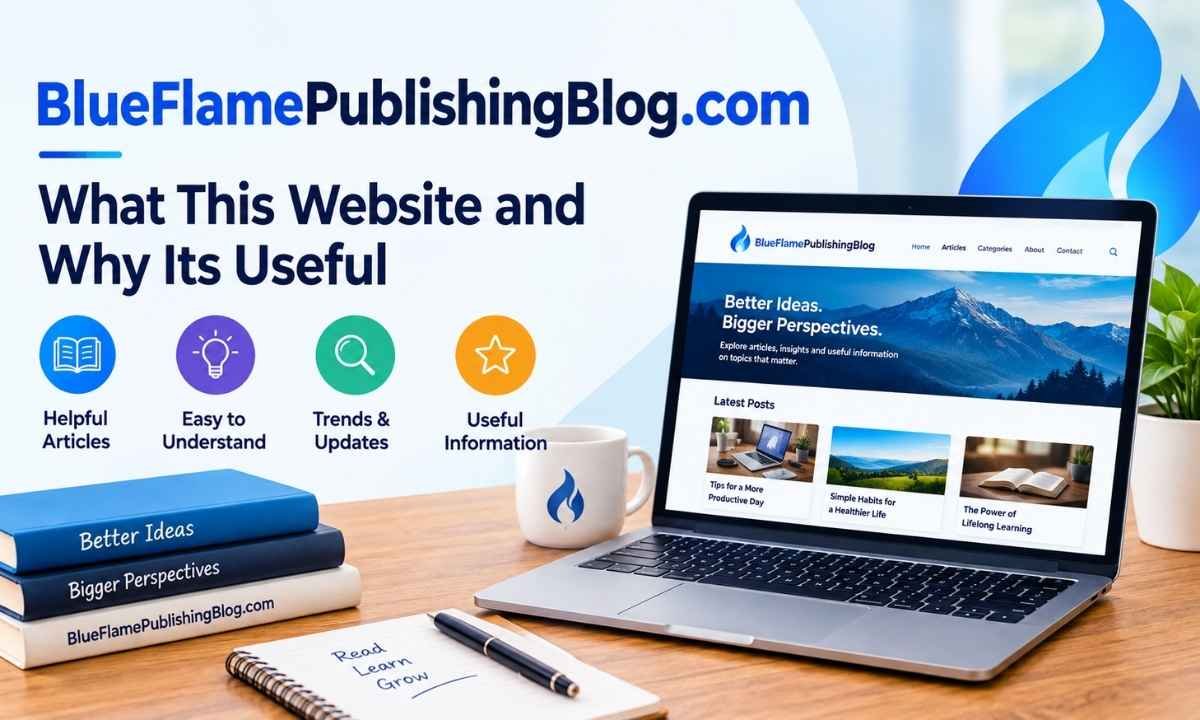
Short answer: BlueFlamePublishingBlog.com is a general-interest blog, not a book publisher. Its menu lists Business, Technology, Health and Travel, and its About Us page describes a broad publication for everyday readers. Its public pages name no company owner, so treat it as a useful starting point rather than a final authority.
| Item | What the site shows |
|---|---|
| Type | General-interest blog |
| Menu | Business, Technology, Health, Travel |
| Most active topics | Health and travel |
| Owner named | No |
| Checked on | October 16, 2026 |
What Is BlueFlamePublishingBlog.com Actually About?
At its core, the site is a WordPress blog that publishes short guides on many subjects. It runs a news-style theme, shows a dated stream of posts, and groups them into a few categories. The menu offers no store, no book catalog and no author submission portal.
What the Site Says About Its Purpose
The About Us page, dated August 14, 2026, calls the site an online publication for readers who enjoy useful information, fresh ideas and practical insights. Its stated mission is to publish informative, engaging content that helps people learn and stay informed. Nothing in that text mentions books or authors.
The same page lists the kinds of content readers may find: guides, how-to tips, technology and digital trends, business topics, lifestyle, education, travel, health, entertainment and general interest. It adds that topics may change over time. In other words, the site defines itself by breadth, not by a single specialty.
It also makes a few commitments worth noting. The page tells readers to check publication dates and verify important facts with authoritative sources, invites correction requests, and says health and financial articles are general information only. Those are sensible statements, though a statement is not the same as a documented editorial process.
So, What Should You Understand About the Name?
The name is a brand, and brands do not have to describe content. Plenty of blogs keep a name from an earlier idea and then widen their topics. Here, the footer and the homepage description both talk about publishing and writing tips, which hints at a narrower plan the site never explains.
That matters for search too. People who type the exact domain are often trying to verify the site before trusting it. They may expect a publisher with books, editors and contracts, then find a general blog. Setting that expectation correctly saves time and prevents bad assumptions.
My practical reading is simple. Judge the site by what it publishes, not by what its name suggests. If you wanted a book publisher, an editing service or a literary agent, this is the wrong address. If you wanted general articles to read, it fits.
Why Does the Site Cover Health, Travel, Business, and Technology?

Broad coverage is a deliberate format for many general blogs. A wide topic list attracts more search visits, and it lets the site publish whatever its contributors submit. The menu on BlueFlamePublishingBlog.com shows four main sections, and each one has a different level of activity.
| Section | What I found on October 16, 2026 |
|---|---|
| Business | Posts from October 6 and September 9, 2026 |
| Technology | In the menu, but no posts on the homepage |
| Health | Largest group, from nutrition to OCD |
| Travel | India series and a Bordeaux trip |
The Business and Technology Content
Business holds the freshest posts. The newest article on the homepage, dated October 6, 2026, covers what to ask before hiring an inspection company in Thailand. Another, from September 9, 2026, offers practical insights on modern entrepreneurship. Both suit readers who want general guidance, not audited analysis.
Technology is harder to judge. The top menu lists it, yet the front page shows no technology articles and the sidebar category list leaves it out. The section may hold older posts or none yet. A reader who wants technology coverage should open that section page before relying on it.
A few business posts focus on named platforms and brands, such as guides to Wallpostmedia and SoSoActive. Treat these as informational overviews. If a post describes a product or service you plan to pay for, check the company’s own site and independent reviews before you act.
The Health Content
Health is the largest topic on the site. The November 2025 batch includes posts on vitamin D deficiency, cholesterol, immune habits, sleep and post-workout nutrition. Later posts cover intrusive thoughts in OCD, from March 2026, and facial massage, from September 2026. Together they read like standard wellness explainers.
Health is also where the visible reach looks biggest. View counters on the homepage show 5,935 for a post on vitamin deficiency in women and 2,975 for one on lowering cholesterol. Those figures come from the site itself, so read them as the site’s own claim rather than verified readership.
Health pages carry the highest stakes, so they deserve the closest reading. Many are credited to a generic site account rather than a named doctor, dietitian or psychologist. That does not make a post wrong. It does mean you cannot see who stands behind the advice.
The About Us page itself says health articles are not a substitute for professional medical advice, diagnosis or treatment. Take that line seriously. Use these pages to learn vocabulary and form questions, then confirm anything that affects a symptom, a medicine or a diagnosis with a qualified clinician.
The Travel Content
Travel content falls into two groups. The first is a November 2025 series on India, covering yoga retreats for beginners, romantic getaways, family trips, offbeat places for solo travelers and tiger safaris. The second is a February 2026 piece on visiting Bordeaux by train, tram and day tour.
Travel posts age quickly. Prices, opening hours, entry rules and park permits change often, and a post from late 2025 may already be out of date. Use these guides for ideas and route shapes, then confirm current details on official tourism, park or transport pages before you book.
What This Means for You
The mix tells you the site is built for general browsing. Someone can land on a vitamin D post, then a Bordeaux itinerary, then a business checklist. That variety suits casual reading but gives little proof of deep expertise in any single area.
Matching your need to the right kind of page helps. Here is how I would sort common uses:
- Casual wellness reading: a reasonable starting point.
- Trip ideas: good for inspiration, weak for logistics.
- Business checklists: useful prompts, not due diligence.
- Medical, legal or financial decisions: use professional sources.
Put simply, the site works as a source of ideas and plain-language overviews. It does not work as a primary reference.
Is BlueFlamePublishingBlog.com a Publishing Company or a Content Website?
It is a content website. A publishing company acquires, edits, produces and sells works such as books or magazines. A content website posts articles for readers and search engines. The public pages of this site match the second description far more than the first.
Why the Difference Matters
The distinction affects what you can expect from the site. A publishing company has editors, contracts, royalties and a catalog. A blog has posts, categories and a comment box. Mixing them up leads authors to send manuscripts to a place that does not accept them.
It also affects trust. Readers often assume a publisher has gatekeepers who check facts before release. A general blog may or may not have that process. The only way to know is to look for editorial policies, named editors and correction records, then judge what is visible.
| Feature | Publishing company | Content website |
|---|---|---|
| Output | Books, journals | Articles, guides |
| Staff | Named editors | Often unnamed writers |
| Revenue | Sales, licensing | Ads, sponsored posts |
| Key check | Catalog, contracts | Author bios, dates |
What the Current Website Actually Shows
The front page shows a news-style theme with post cards, category tags and view counters. The menu offers Business, Technology, Health, Travel, a Privacy Policy and About Us. I found no book catalog, no manuscript submission form and no author services page anywhere in that menu.
The archive gives clues about activity. Monthly archives list December 2024, November 2025, then February, March, April, September and October 2026. That pattern points to bursts of posting rather than a steady daily schedule, which is common for smaller blogs.
Another detail stands out. The footer credits a commercial theme vendor, and the layout, with its Latest Posts and Trending Posts tabs, matches a standard WordPress news template. Nothing suggests a custom publishing platform or a production workflow behind the posts.
What You Should Not Assume
Do not assume the owner is a book publisher, an agency or a registered company. The footer lists a Gmail-style contact address and no company name, and I found no registration details on the homepage or the About Us page. That absence is not proof of wrongdoing. It simply leaves the question open.
Do not assume the view counters prove traffic either. Posts on the homepage show counts that range from zero to 5,935. Those numbers come from the site itself, and nobody has independently verified them. Treat them as decoration unless an analytics source backs them up.
A short list of assumptions to avoid:
- That the site sells or edits books.
- That the counters equal real readership.
- That every health post has an expert reviewer.
- That the name matches the focus of the content.
Are BlueFlamePublishingBlog.com and Other BlueFlamePublishing Domains the Same?
Not necessarily, and I found no evidence that they are connected. Searching the brand name returns pages about several similar domains, including a .net variant, and many of those pages sit on unrelated third-party sites. They describe a publishing service in generic terms, which makes them hard to verify.
Why Similar Names Can Be Confusing
Domain names that share a stem often belong to different owners. One may be a blog while another sells services. Search engines show them under the same brand words, so the differences blur quickly for a casual visitor who only skims the results.
The articles I found about the .net variant read like templated text. They repeat the domain name in nearly every sentence and promise editing, printing and distribution without naming a team, an address or a price. I could not verify who runs that domain or whether it connects to this blog.
I also could not confirm what a .org version hosts. If a page claims that two domains share an owner, ask for proof, such as matching contact details, shared legal text or an official link from one site to the other.
How to Tell Which Website You Actually Found
A few quick checks separate look-alike domains, and each takes under a minute. Run through them before you share personal details, send a manuscript or pay for anything. The table below shows what to look at and what a mismatch tells you.
| Check | What to look for |
|---|---|
| Address bar | Exact spelling and ending, such as .com |
| Footer | Brand name matching the menu |
| About page | A real description of owner and purpose |
| Contact page | A named person or company |
| Content | Topics that match the name |
The Simple Rule
Treat each domain as its own site until proof says otherwise. Proof means shared ownership details, matching legal pages or a visible link placed by the owner. A similar name alone proves nothing, and neither does a page that repeats the brand word many times.
For this guide, BlueFlamePublishingBlog.com means the .com blog with Business, Technology, Health and Travel in its menu. Anything else is a different page until you can show a clear link. If the address in your browser differs by even one character, you are on another site.
Who Appears to Be Behind BlueFlamePublishingBlog.com?
The honest answer is that the public pages do not name an owner. They do show a few clues about who writes and who handles contact. Those clues are worth reading, as long as you stop where the evidence stops. A name on a page is data; a story about that name is speculation.
What You Can See From the Site
Posts show author labels of two kinds. Most use a generic account name built from the site name and a short code. A few credit named profiles, including Devin Haney on the OCD and Bordeaux articles and a username, itsrana, on a business post.
The footer gives a Gmail-style contact address and says the site’s community is not responsible for external sites. The About Us page points readers to a Contact Us page for questions, corrections and business inquiries, and it asks that error reports include the article title.
The Privacy Policy sits in the main menu, which is a good sign for basic transparency. I did not review its full text, so read it yourself if you plan to submit data or sign up for anything. Look for who controls the data and how to request removal.
What You Should Not Guess
Do not infer identity from a username or an email prefix. Names can be pen names, shared accounts or contractor profiles. Publishing a guess about a real person based on a footer address is unfair and often wrong, and it does not help you evaluate the articles.
You also should not assume the named authors hold credentials in the subjects they cover. The pages I saw do not show detailed biographies, degrees or professional histories. Absence of a bio means you cannot verify expertise, not that expertise is missing. Ask the site if the detail matters to you.
If the answer matters, send the site a short message with these questions:
- Who owns and edits the blog?
- Who writes the health posts, and what are their qualifications?
- How are corrections handled?
- How can a post be reported or removed?
Can You Trust Everything Published on BlueFlamePublishingBlog.com?
No site earns blanket trust, and this one is no exception. Reliability varies by article, by topic and by what you plan to do with the information. A better question is which pages you can trust for which purposes. The sections below give a method you can reuse on any general blog.
Start With the Article, Not Just the Website
Check the individual page before you accept a claim. Look at the publication date, the author label, any cited sources and whether the advice matches what major institutions say. A weak site can host a careful post, and a strong site can host a careless one.
Dates matter most on this blog. The homepage mixes posts from November 2025 with posts from October 2026, and the About Us page itself warns that information can change. If a post gives no date or no sources, lower your confidence and compare the claim with a second source.
A five-minute check works for most posts:
- Read the date and ask whether the topic changes quickly.
- Find the author label and look for credentials.
- Search the main claim on a government or hospital website.
- Note any figure, price or dosage and verify it separately.
General Information Is Different From High-Stakes Advice
Casual reading carries little risk. Decisions about your body, money, legal position or safety carry much more, and those call for stronger sources. The table sets out how I would weigh this blog for different jobs. Think of it as a sliding scale rather than a yes or no.
| Use | Trust level | Better source |
|---|---|---|
| Casual reading | Reasonable | Optional |
| Trip ideas | Moderate | Official tourism sites |
| Health symptoms | Low | Doctor, health agency |
| Money or legal choices | Low | Licensed professional |
| Choosing a vendor | Low | Company site, reviews |
A Simple Example
Here is a real case from the site. A November 2025 post on the term apothorax says it is not recognized as a standard anatomical term and is likely a misunderstanding. A March 2026 guide then presents it as a word with both historical and modern significance, tied to the thoracic region.
The two pieces do not agree, and a person searching for the word would meet both framings on the same site. The lesson is not that the blog lies. It is that contributors’ pieces may not be reconciled, so you need to cross-check. For anatomy terms, a medical dictionary settles the question quickly.
The Practical Answer
You can trust the site as much as any general blog: enough to get oriented, not enough to decide. Read posts as summaries written for lay readers. Verify the facts that matter, and keep a note of where you checked them so you can revisit the answer later.
One more observation from October 16, 2026: the Recent Comments widget on the About Us page listed several links to external betting and gambling sites. That points to weak comment moderation. Avoid clicking links in comments, and do not treat comment sections as part of the site’s editorial voice.
What Is BlueFlamePublishingBlog.com Useful For?
Used with care, the blog has real value. It is a free, readable collection of plain-language articles across a few everyday topics. That makes it a decent first stop, provided you know what it does well and when to move on. Here is how I would use it.
Use It as a Starting Point for Research
When a topic is new to you, a short overview helps you collect terms and questions. A post on vitamin D or Bordeaux can give you the vocabulary and the basic shape of the subject. That saves time before you open more formal sources. Write down the terms and claims worth checking.
Skim a post for named facts, such as dosages, dates, prices or legal rules. Those are the items that go wrong most often. Mark them, then verify each one in a primary source like a health agency, a government page or an official booking site.
Use Topic-Specific Articles for Ideas
Some posts work well for brainstorming. The India series can help you shortlist regions for a trip, and the Bordeaux post shows how to plan a wine visit without renting a car. The business piece on inspection companies gives you questions to bring to a supplier meeting.
Ideas are cheap to test. If a post offers a list of questions for a vendor, you can keep the useful ones and discard the rest. Nothing is lost if the post is imperfect, because you are using it to prompt your own thinking rather than to settle anything.
Know When to Move to Another Source
Move on when a topic touches your health, money or legal position. Switch sources as well when a post makes a strong claim without citing anything, or when it covers a fast-changing topic like travel rules and is more than a year old. Those are the moments when a general blog falls short.
Better sources depend on the topic. For medical questions, use national health agencies, hospital systems and licensed clinicians. In travel, use official tourism boards and transport operators. For business choices, use company filings, contracts and independent reviews. A quick check often takes only five minutes.
What If You Found BlueFlamePublishingBlog.com Through a Guest-Post Offer?
Many visitors reach this domain because a guest-post seller listed it. That context changes the questions you should ask. Marketplace listings describe the site as a place to buy a published article with links, so the focus moves from reading to buying and from content to terms.
What a Guest-Post Listing Can Tell You
According to an SEO review published by Ranktracker on August 3, 2026, the Vefogix marketplace lists the site at $64 for an article with up to two permanent do-follow links, 1,000 to 2,500 words and about two days to publish. I could not open the live listing, so confirm current terms with the marketplace.
| Listing detail | Reported figure |
|---|---|
| Price | $64 |
| Links | Up to 2, do-follow |
| Word count | 1,000 to 2,500 |
| Turnaround | About 2 days |
| Domain Authority | 43 |
| Domain Rating | 28 |
| Semrush traffic | 841 |
Source: Ranktracker review of the Vefogix listing, August 2026. Figures are the marketplace’s own, not independently verified.
The review also reports that the 58,700 monthly visits shown in its screenshot belong to the Vefogix sales page, not to this blog. That page ranks for the exact domain name, which is why searching the brand often shows a sales listing first. The publisher’s own Semrush figure is 841, a very different number.
The review adds several conditions. The listing reportedly refuses adult, CBD and casino content, bars titles and anchor text containing words such as best, review, buy, cheap and top, and does not sell footer or sidebar links. It offers homepage banners for at least three months, and the publisher may edit titles, images and wording.
What You Should Consider Before Paying
Google’s spam policies say paid links should carry a rel attribute of sponsored or nofollow. A do-follow link bought mainly to influence rankings can count as link spam. That risk sits with the buyer, so weigh it before you pay, especially for a brand you plan to keep for years.
Check the page, not the metrics. Domain Authority and Domain Rating come from third-party tools, and Google does not use them. Ask whether similar posts are indexed, linked from the homepage or category pages, and drawing visitors. Ask whether the topic fits the site and whether the link is labeled sponsored.
Before you buy, work through this list:
- Search the exact title of a comparable post to see whether it is indexed.
- Inspect the link’s rel attribute in the page source.
- Confirm the post will be linked from a category page or the homepage.
- Ask who the publisher is and how removals are handled.
- Confirm the price and terms on the live listing.
Keep the Two Questions Separate
Whether the site is worth reading and whether a paid placement on it is worth buying are different questions. A blog can be fine for casual reading and a poor fit for a link purchase. Another can be a good link location and a weak reading source.
If you are a reader, ignore the marketplace figures and judge each article. If you are a buyer, ignore the homepage view counters and judge the exact page you would appear on. Mixing those lenses leads to wrong conclusions in both directions, so decide which role you are in first.
What Should You Understand About BlueFlamePublishingBlog.com?
BlueFlamePublishingBlog.com is a general-interest blog with Business, Technology, Health and Travel in its menu, and its content leans toward health and travel. It is not a book publisher. The name points toward publishing, while the pages deliver broad lifestyle articles for everyday readers.
The site does not publicly name an owner or detailed author credentials, and at least one of its own health topics appears with conflicting framings. Use it for orientation and ideas. Confirm anything high stakes with professionals or primary sources, and check dates before relying on any claim.
If a seller pitched the domain to you, treat the marketplace figures as claims to verify, not facts. Judge the exact page, the link label and the real traffic. Handled that way, you lose little and you avoid the most common mistakes people make with this site.
Frequently Asked Questions
Is BlueFlamePublishingBlog.com still active?
Yes. The homepage showed posts as recent as October 6, 2026 when I checked on October 16, 2026.
Does BlueFlamePublishingBlog.com only cover publishing?
No. Its menu lists Business, Technology, Health and Travel, and most visible posts cover health and travel.
Is BlueFlamePublishingBlog.com the same as BlueFlamePublishing.org?
I found nothing that links them. Treat them as separate sites unless ownership is proven.
Does BlueFlamePublishingBlog.com provide health information?
Yes, in general wellness articles. Its About Us page says they are not a substitute for professional medical advice.
Does BlueFlamePublishingBlog.com accept guest posts?
A marketplace listing offers paid placements, but I could not verify terms on the site itself. Confirm with the publisher.
Should you use the website as your only source?
No. Use it as a starting point and verify anything important with an authoritative source.